
This report explores the avenues that the electrification and power sector provides for emissions reduction vis-a-vis long-term climate objectives. It discusses three key issues: price signals, cost allocation, and innovation.
The objective of this paper is to provide information and estimates about the impacts of managing the large number of lithium-ion batteries for electric vehicles that enter the market and will reach the end of their life in the coming years. The analysis compares two different hypothetical scenarios involving different levels of ambition regarding battery collection rates for recycling in Europe and the recycling efficiency rate for different materials.
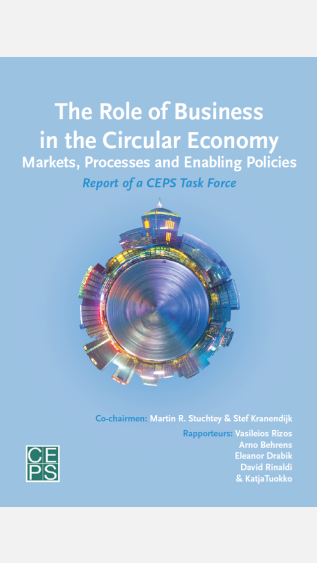
This report The Role of Business in the Circular Economy: Markets, Processes and Enabling Policies analyses the key obstacles that need to be addressed in circular economy, explores numerous policy areas at the EU and national level where support can act as a catalyst for market transformation, and puts forward actionable policy recommendations.
In recent years the circular economy has received increasing attention worldwide due to, inter alia, the recognition that security of supply of resources and environmental sustainability are crucial for the prosperity of countries and businesses. G20 countries should consider developing frameworks that enhance the circular economy and more generally sustainable production and consumption modes. In this context, they should 1) integrate the circular economy into discussions about implementing the 2030 Agenda for Sustainable Development and the Paris Agreement, 2) work towards agreed terminologies for circular economy products and processes, 3) support demand for circular economy products and services, 4) support transparency across global supply chains, 5) facilitate financing for establishing circular supply chains and 6) proactively address the transition issues.
Transforming the linear economy, which has remained the dominant model since the onset of the Industrial Revolution, into a circular one is by no means an easy task. Such a radical change entails a major transformation of our current production and consumption patterns, which in turn will have a significant impact on the economy, the environment and society. Understanding these impacts is crucial for researchers as well as for policy-makers engaged in designing future policies in the field. This requires developing an in-depth knowledge of the concept of the circular economy, its processes and their expected effects on sectors and value chains. This paper reviews the growing literature on the circular economy with the aim of improving our understanding of the concept as well as its various dimensions and expected impacts. On the basis of this review, it attempts to map the processes involved and their application in different sectors. The paper suggests that research on the circular economy is currently fragmented across various disciplines and there are often different perspectives and interpretations of the concept and the related aspects that need to be assessed.
Small and medium-sized enterprises (SMEs) are increasingly aware of the benefits of closing loops and improving resource efficiency, such as saving material costs, creating competitive advantages, and accessing new markets. At the same time, however, various barriers challenge small businesses in their transition to a circular economy, namely a lack of financial resources and a lack of technical skills.
This paper aims to increase understanding about the barriers and enablers experienced by SMEs when implementing circular economy business models. The authors recommend that European and national policies strengthen their focus on greening consumer preferences, market value chains and company cultures, and support the recognition of SMEs’ green business models. This can be achieved through the creation of dedicated market places and communities of practice, for example.