
Building Sustainability and Circularity in the Textile Value Chain
The textile industry is one of global importance, and one of the largest contributors to the climate and ecological crisis and facilitated by an underpaid workforce facing discrimination, unsafe working conditions and harassment. The United Nations Environment Programme (UNEP) works on providing strategic leadership and encouraging sector-wide collaboration to accelerate a just transition towards a sustainable and circular textile value chain. Read more about the activities of UNEP, the Sustainable Fashion communication strategy, have a look at UNEPs webpage or watch the recording of our global webinar: Shifting the Fashion Narrative: 'Rethinking aspiration in a world of overconsumption' of November 2022.
Early 2023: Fashion Industry Target Consultation: Regional Workshops & Global Survey
Each region has a different relationship with the textile value chain, and a global set of targets and monitoring must incorporate this to ensure that there are no tradeoffs, while also ensuring environmental and social protections. Together with the non-profit organization Global Fashion Agenda, UNEP has launched the Global Survey, based on a proposed set of unified targets for a sustainable fashion industry. If possible, based on existing targets, and once finalized, they will be voluntary but influential in aligning the fashion industry to achieve a shared vision. Everyone working or interested in sustainable fashion is invited to participate in this global survey. It will help us to understand if the proposed targets will help achieve the priority areas, if the level of ambition is correct, and what you would need to achieve the targets.
Besides this survey, virtual regional workshops will be hosted to ensure that developing countries and SMEs views are reflected in the consultation. (More information about the Fashion Industry Target Consultations and the regional workshops).

The textile and fashion situation in West Asia
In West Asia textiles plays an important role in history and culture, but it is not yet considered a priority for addressing sustainability. After many years of importing fashion from Europe and North America, the region has started to export their fashion. The success of designers such as Lebanon’s Rami Khadi, Rabih Kayrouz and Elie Saab, Kuwait’s Yousef Aljasmi and Bahrain’s Hala Kaiksow has led to increased attention to West Asian fashion (Iftahy et al., 2019; UNEP), and to fashion hubs in UAE, Qatar and Lebanon. Recent studies show that 75% of respondents in West Asia prefer to buy from eco-conscious fashion companies, compared to 54% globally. (Khamis, 2022). In the UAE, the average person spends 1,600 USD annually on fashion, which is double the US average (Koelblin, 2021). With the large and growing market quickly developing toward online fashion and production and consumption moving toward sustainability, there is a huge potential to influence the process.
Q1 - 2022: The West Asia Sustainable Fashion Academy (WASFA)
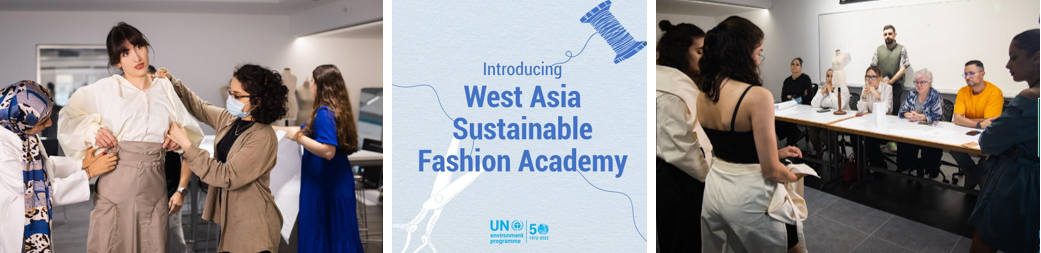
The Academy aims at bringing together experts and stakeholders from various fields to share knowledge, build capacities, and mainstream sustainable production and circularity in the textile value chain. It also intends to instigate a behavioural change through a shift to more sustainable consumption patterns with a specific focus on the youth. In the first semester of 2022, training sessions were conducted, targeting different stakeholders with over 70 participants from 9 countries from the region: 2-day workshop on Eco-Innovation & Sustainable Textiles (targeting SMEs), 1-day training on circularity and Upcycling (targeting NGOs) and a 3-day Eco-Design Marathon on Zero Waste Fashion (targeting students).
November 2022: Black Friday Activities in West Asia
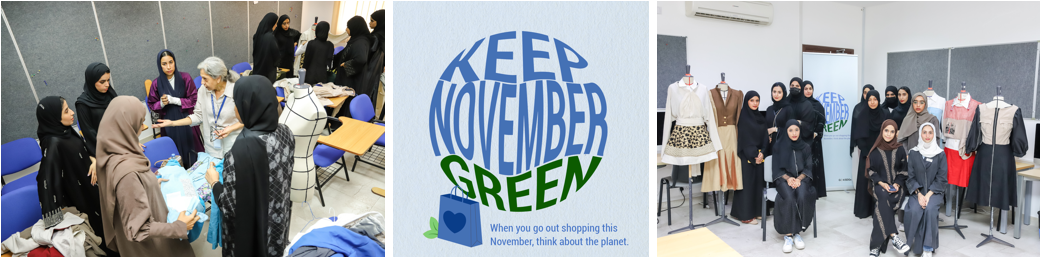
During the week of Black Friday West Asia carried out workshops with universities in Bahrain, Oman, Lebanon to raise the consumers awareness on the impacts of fast fashion and to communicate everyone’s responsibility to make the right choice in our purchase patterns. To encourage university students to repurpose, reuse, and redistribute unwanted clothes, they were asked to collect clothes, 70 students turned them into new outfits during workshops, and the rest was donated to the community. For more information watch our video: https://youtu.be/sq-49DUSURI.