
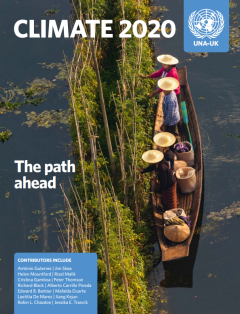
This report focuses on the path to net zero; the next and most pressing challenge that the global community faces. It equips policy-makers, practitioners, and interested observers with insights on how to make the agreement a reality in this make-or-break year. It features short, incisive articles from 30 authors drawn from the UN system and from governments, the private sector, academia, and civil society. They include:
- António Guterres (UN Secretary-General)
- Jim Skea (Imperial College)
- Helen Mountford (World Resources Institute)
- Rizal Malik (WWF)
- Cristina Gamboa (World Green Building Council)
- Peter Thomson (UN Special Envoy for the Ocean)
- Richard Black (Energy and Climate Intelligence Unit)
- Alberto Carrillo Pineda (CDP)
- Edward B. Barbier (Colorado State University)
- Mafalda Duarte (Climate Investment Funds)
- Laetitia De Marez (Climate Analytics New York)
- Jiang Kejun (National Development and Reform Commission, China)
- Robin L. Chazdon ( World Resources Institute)
- Jessika E. Trancik (Massachusetts Institute of Technology)
The present political, economic, and social landscape has been dramatically altered by the COVID-19 crisis, and this group of authors advocates that the international community must not lose sight of the urgent need for climate action. Throughout the report, they make the case that the technological, financial, and social incentives and mechanisms can enable us to avoid the most harrowing and catastrophic climate future, if they are implemented.
Together, the articles provide a source of practical actions, approaches, analysis, and case studies on how the hard-won Paris deal remains the foundational framework that is needed - namely, one that is robust, equitable, and able to deliver long-term benefits to all.