
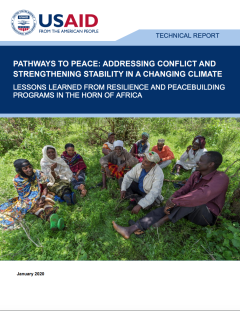
There is increasing evidence and recognition that climate variability and change is a risk multiplier that can exacerbate social, economic, and environmental pressures, such as rapid urbanisation, social inequality, economic shocks, and environmental degradation. This is especially true for communities that are highly dependent on natural resources for their livelihoods.
This report critically assesses how peacebuilding programming can also produce adaptation benefits (and vice versa), so that interventions simultaneously contribute to reduced intercommunal conflict and strengthened resilience to a range of shocks and stresses, including droughts, floods, and rainfall variability. It draws on the evaluations of three USAID programs in the Horn of Africa, as well as other relevant programs that included peacebuilding and climate change adaptation components, to synthesise lessons learned, develop and test a theory of change, and offer recommendations on integrating programmatic approaches that consider and address compound climate–fragility risks.