
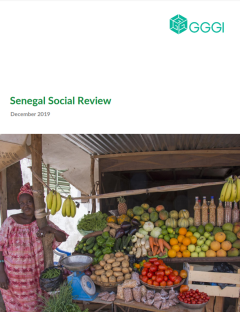
Produced by the Global Green Growth Institute (GGGI), the Senegal Social Review provides an overview of the legal and policy framework for Senegal around gender-responsiveness and socially inclusive approaches to achieve the contribution towards Sustainable Development Goals (SDGs) and its Nationally Determined Contribution (NDC). It recommends some key entry points and ways to improve gender-responsiveness and socially inclusive approaches, including:
- Social and gender assessments: It is critical that all development and economic interventions conduct social and gender assessments during the design/planning/needs assessment stages.
- Inclusive economies and decent jobs: There is need to improve productivity in sectors where the poor are more active and strengthening social protection mechanisms. Deliberate efforts need to be made by having programs that focus on women and youth in rural and peri-urban areas of the country. Additionally, the government and private sector need to reduce discrimination in labor markets and work on gender transformative approaches to ensure that women are included as beneficiaries and decision-makers.
- Gender sensitive urban planning: Ensure that urban and rural planning and designs respond to the different gender needs identified by all gender and social groups.
- Institutional capacity building: It is important that the country takes initiatives in building individual and institutional capacities for nationally-owned green economy processes for effective local ownership, success, and sustainability—deliberately targeting the Government line ministries and departments with the mandate of gender coordination and mainstreaming, women’s groups/organisations/networks, academia, and other non-state actors.
- Gender sensitive policy development: The development of climate-related policy documents should ensure that gender considerations are taken on board. This should be coupled with ensuring that there are budget allocations that respond to the gender-specific needs identified in the policies/strategies/plans.
- Equal opportunities in access to and ownership of land: There is need for translation and massive sensitisation of the land laws to increase the awareness around women’s land rights and to contribute towards women becoming more economically autonomous.
- Village level social economics: As rural development provides entry point for development of agriculture, agroforestry, and livestock raising, there is need to recognise that measures to adapt to climate change must first and foremost be taken at the village level, where social norms are largely built.
- Inclusion and participation of socially excluded and marginalised groups: Consultations for the planning and design of urban and rural services need to ensure that locals, especially the marginalised groups including women, women groups, youth, and peri-urban poor people.
- Inclusive and sustainable climate finance: The Government and its development partners need to ensure that sustainable climate finance initiatives are properly designed and implemented by addressing the socio-political imbalances (including gender imbalances) at all levels, especially imbalances that weaken their resilience to climate change impacts.
- Gender responsive investments and governance: All types of green investments and governance frameworks be gender responsive in order to ensure that climate finance is effective and equitable.
- Alternative energy technologies and income generation activities: Promote alternative energy technologies and improve income generating activities that train and empower rural women to reduce deforestation and adapt to the impacts of climate change.