


The World Trade Organization (WTO) has espoused a commitment to sustainable development, yet current WTO rules are in tension with global environmental protection efforts. Understanding and improving WTO law in the area of the environment is crucial to regulating and incentivizing certain subsidies benefiting renewable energy. Green subsidies and the WTO, authored by Steve Charnovitz and posted as a World Bank working paper, provides a tool to assist governments in adopting green subsidy measures that comply with somewhat ill-defined WTO laws, and presents a call to action to improve these WTO rules in the area of renewable energy.

Tension Between Trade Law and Green Subsidies
Green subsidies are financial benefits given by the government to groups or individuals to improve sustainability over what would naturally occur in the market. When a green subsidy causes a transborder economic effect, the rules governing the world trading system come into play. Trade disputes can arise when a foreign subsidy appears to cause an adverse effect on a trading partner. See, for example, Carolyn Fischer and Steve Charnovitz’s recent publication “Canada–Renewable Energy: Implications for WTO Law on Green and Not-So-Green Subsidies”.
The General Agreement on Tariffs and Trade (GATT) provided some rules to govern subsidies that distort trade, but when the WTO was created in 1995 with a new Agreement on Subsidies and Countervailing Measures (SCM), the regulatory ambition vastly expanded. Now WTO law creates conditions under which WTO Members are prohibited from employing certain kinds of subsidies.
Trade disputes can lead to a WTO recommendation that a subsidy be withdrawn. As a result, governments concerned about acting within the bounds of the SCM Agreement may become hesitant to use innovative subsidies that are contrary to current trade law, or that have an uncertain legal status. Ultimately, this tension between trade law and green initiatives is stalling global progress towards clean energy industries, and chilling environmental regulation and trade cooperation.
Fixing WTO Inadequacies
As trade conflicts over green subsidies continue to gain frequency, calls for the improvement of WTO rules become more salient. One problem is the expiration of SCM Part IV, which initially provided policy space for non-actionable subsidies including environmental adaptation subsidies. Unfortunately, Part IV expired in 2000. In addition, WTO rules lack the clarity necessary for governments to know in advance whether their green subsidies are WTO-legal.
To address the tension between WTO law and green initiatives, this research considers potential WTO law reforms to permit and incentivize well-designed green subsidies. This paper considers the justifications for and criticisms of green subsidies, illustrates ways that green subsidies are being used, and details how international economic and environmental law governs green subsidies. This research also questions the use of subsidies altogether and suggests that carbon taxes may be more appropriate. See, for example, South Africa’s carbon tax program, which will likely go into effect in 2016.
The study then makes a case for clarifying WTO rules in the area of green subsidy regulation, relaxing WTO rules on green subsidies that adversely affect the interests of other WTO members, and calls for the creation of a system of WTO law that is more compatible with environmental subsidies. In addition, the paper proposes modernizing disciplines for countervailing duties by requiring governments to consider the domestic consumer interest before imposing countervailing duties on green imports such as solar panels.
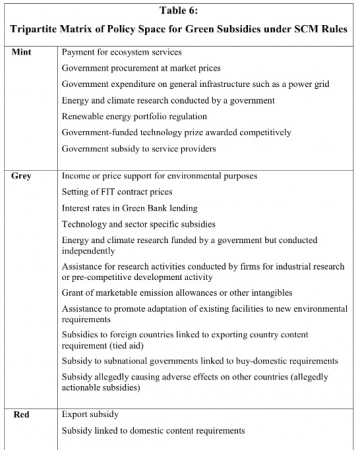
To bolster public understanding about the potentials for green growth, the study provides a chart that places environmental subsidies into three colored categories: mint (permitted), red (disallowed), and grey (contingent status). WTO rules seek to prevent the red area subsidies, which are by design discriminatory or trade distorting, and grey area subsidies when they cause adverse effects. This chart, therefore, serves to assist governments in crafting subsidies in a way that minimizes trade distortions, and minimizes the likelihood that the subsidies will be found in violation of WTO rules. The chart, contained in Table 6 of the paper, is shown below.
Until this clash between trade law and environmental initiatives is understood and addressed, WTO law may continue to stall clean energy progress. This study provides a tool for governments to use to ensure green subsidy measures do not violate the current system of WTO law, and presents a call to action to improve WTO rules in the area of renewable energy.