UNEP International Environmental Technology Centre (IETC) and the IGES Centre Collaborating with UNEP on Environmental Technologies (IGES-CCET) co-organised a session on gender and informal sector integration in waste management at SEA of Solutions Forum 2025. The Forum, convened by UNEP and the Coordinating Body on the Seas of East Asian (UNEP-COBSEA) from 16-17 December 2025 in Bangkok, brought together diverse stakeholders from across the Asia-Pacific region, including government representatives, experts, the private sector and youth, to address plastic pollution and marine litter.
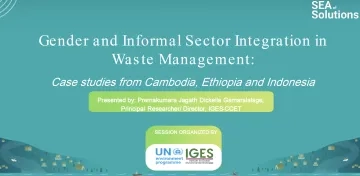
The session introduced UNEP’s upcoming publication, tentatively titled Gender and Informal Sector Integration in Waste Management: Case studies from Cambodia, Ethiopia and Indonesia. The authors, Dr. Premakumara Jagath Dickella Gamaralalage (Director, IGES-CCET), Ms. Siti Ainun (Lecturer, Institut Teknologi Nasional Bandung, Indonesia) and Ms. Sereyroth Lim (Gender Equality and Social Inclusion Consultant, Cambodia), presented their preliminary findings from Cambodia and Indonesia, highlighting that waste management is not only a technical or environmental issue but is also influenced by gender norms, social structures and economic inequalities.
The report finds that while women often play central roles in household waste management and informal recycling, they remain under‑represented in decision‑making and higher‑income roles. It identifies six enablers for gender‑responsive and inclusive waste systems, including policy coherence, community-based models, capacity building and inclusive infrastructure.
Related Case Studies