
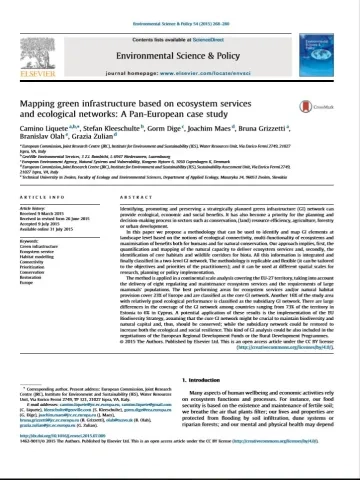
This case study proposes a replicable methodology that can be used to identify and map green infrastructure elements at the landscape level, based on the notions of ecological connectivity, multi-functionality of ecosystems, and maximisation of benefits both for humans and for natural conservation. The method is applied in a continental scale analysis covering the EU-27 territory, taking into account the delivery of eight regulating and maintenance ecosystem services and the requirements of large mammals’ populations.
The approach implies, first, the quantification and mapping of the natural capacity to deliver ecosystem services and, secondly, the identification of core habitats and wildlife corridors for biota. All this information is integrated and finally classified in a two-level green infrastructure network. The methodology is replicable and flexible—it can be tailored to the objectives and priorities of the practitioners and it can be used at different spatial scales for research, planning, or policy implementation.
The best performing areas for ecosystem services and/or natural habitat provision cover 23 percent of Europe and are classified as the core green infrastructure network. Another 16 percent of the study area with relatively good ecological performance is classified as the subsidiary green infrastructure network. There are large differences in the coverage of the green infrastructure network among countries, ranging from 73 percent of the territory in Estonia to 6 percent in Cyprus. A potential application of these results is the implementation of the EU Biodiversity Strategy, assuming that the core green infrastructure network might be crucial to maintain biodiversity and natural capital and, thus, should be conserved; while the subsidiary network could be restored to increase both the ecological and social resilience. This kind of green infrastructure analysis could also be included in the negotiations of the European Regional Development Funds or the Rural Development Programmes.
Related Case Studies
This report presents a state-of-the-art contribution of information to decision-makers in Laos who have an interest in achieving sustainable growth consistent with the 2019 National Green Growth Strategy.
This report evaluates how closely the outcomes of first global stocktake align with Malaysia’s current NDCs and other climate policies for mitigation and adaptation.
This case study presents a discussion on the possibilities of implementing and using energy accounts in developing countries as a complement to traditional energy balances and statistics, which is particularly applicable in Central American countries.
This case study examines alignment between the natural capital accounting approach of Holcim in Spain with the System of Environmental-Economic Accounting (SEEA), with a particular focus on biodiversity measurement for quarry restoration efforts.