
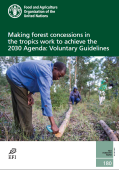
Forest concessions have long been used as an instrument for the allocation of rights to harvest and manage public forests in both northern and southern countries. In the context of the 2030 Agenda, forest concessions can be used as policy instruments to regulate production from natural forests consistent with biodiversity conservation and ecosystem service...

In promoting and supporting the development of eco-industrial parks, UNIDO aims to mainstream and upscale the application of Resource Efficient and Cleaner Production (RECP) by businesses and government and contribute to sustainable consumption and production.
These Guidelines on business and Key Biodiversity Areas (KBAS) have been developed by the KBA Partners to support businesses in managing risk to biodiversity.
This toolkit, based on existing good practice, aims to help governments in the EU’s Eastern Partnership (EaP) countries to design and implement key instruments to promote environmental compliance and green business practices among small and medium-sized enterprises.
How does green lending work? How can it be implemented within your institution? The Global Climate Partnership Fund (GCPF) practitioner’s guide to green lending is designed to answer these questions.

This joint UNIDO-OECD Stakeholders’ Guidebook aims to help Small and Medium-sized Enterprises (SMEs) in the European Union Eastern Partnership countries find efficient and effective financial solutions to support Resource Efficient and Cleaner Production (RECP) measures in their operations.
Social conditional transfers (CTs) and payments for ecosystem services (PES) have the same starting point: the assumption that direct, conditional incentives are the most effective way to change behaviour. However, contextual disadvantages affect the capacity for the very poor to comply. Recognising this is important in the design of inclusive...

This extensive guidance Canada’s Next Edge: Why Clean Innovation is Critical to Canada’s Economy and How We Get It Right explores how to turn these policy and finance commitments into action while continuing to flesh out other key parts of the clean innovation policy framework.
The GCD Guidelines provide guidance on how to plan and implement GCD at every stage of the GGGI Value Chain. They serve as reference for government officials, GGGI staff and consultants, and other stakeholders who are working on areas related to or looking to develop a project on green cities.
The Global Green Growth Institute (GGGI) developed these guidelines in order to define a green growth planning process.