Project Purpose and Objectives
Funded by the Korea International Cooperation Agency (KOICA), the Global Green Growth Institute (GGGI) will implement in Uzbekistan the ‘Green Rehabilitation Investment Project for Karakalpakstan Republic to address impacts of the Aral Sea crisis’. The project aims to assist the green rehabilitation of the Republic of Karakalpakstan in addressing the impacts of the Aral Sea ecological crisis. The project will establish viable measures to allow communities of the most disaster afflicted districts to pursue disaster resilient sustainable livelihoods through climate-resilient agri-business models. It will also provide the policy, financing, and investment frameworks to allow these to be scaled up. The project will support disaster-risk reduction, improve food security, and enhance livelihoods and job creation in an integrated approach by integrating the dissemination of well-established climate smart agriculture techniques that will increase yields with support for enabling environments for emergence of climate resilient farmers and MSMEs.
For this, the project interventions aim to achieve the following objectives:
- Objective 1: Establish an effective green rehabilitation investment plan targeted on agriculture and agri-businesses that reduces disaster risk, enhances rural food security and sustainable livelihoods, and promotes equitable employment in green and climate-smart value-chains in Karakalpakstan;
- Objective 2: Respond to the most urgent needs of the workforce and micro-, small-, and medium enterprises (MSMEs) to tackle pressing human security needs, focusing on disaster-related threats to health, livelihoods, productive assets, and agri-business risk management.
- Objective 3: Demonstrate viable climate-resilient agri-business models to rebuild the economic foundation of Karakalpakstan’s agrarian economy; and
- Objective 4: Support the government and banks in mobilizing green/climate finance in support of green MSMEs development in Karakalpakstan
Project Duration and Budget
- Duration: July 2021 - June 2025
- Budget: USD 5.6 million from KOICA, USD 0.3 million from GGGI
Target Country: Uzbekistan
- The Republic of Uzbekistan (Uzbekistan) is a landlocked country with a total land area of 447,400 km2 in Central Asia, south and southeast of the Aral Sea. It is surrounded by five neighboring countries: Kazahkstan, Kyrgyzstan, Tajikistan, Afghanistan, and Turkmenistan. For 2020, Uzbekistan's GDP was USD 57.7 billion, and GNI per capita was USD 1,670. The following key sectors contributed to the GDP in 2019: agriculture, forestry, and fishing - 25.5%; services - 32.2%, and industry - 33.2% (comprising manufacturing, mining, construction, etc.) (World Bank, 2019).
- In Uzbekistan, about 25% of the employed population are involved in agriculture and forestry activities. A high percentage of agricultural work is informal, e.g., unpaid employment in family farms, temporary and seasonal work, and self-employment (World Bank, 2018).
- While Uzbekistan has been working towards achieving its SDG targets, poverty remains one of the country's key challenges. In the Republic of Karakalpakstan, income is below the national average with a persistently high poverty level at 27% that is directly linked to the Aral Sea crisis (Cabinet of Ministers of the Republic of Uzbekistan and UNDP, 2017). Poverty is concentrated in rural areas, distant from economic activity centers and with inferior public services and infrastructure. The urban-rural disparity in poverty is also attributed to low productivity in labor-intensive agriculture, deficiencies in the coverage and quality of infrastructure, informality in the labor market, and regional disparities in funding (Asian Development Bank, 2019).
Target Region: Karakalpakstan
- The Republic of Karakalpakstan is a sovereign state within the Republic of Uzbekistan. It is located in the northwest of the country on the Amu Darya flatlands and southern shores of the Aral Sea. The climate is naturally arid, so the local population has long depended on water from the Amu Darya delta for irrigation in agriculture, and in the past – from the Aral Sea for fishing. With the drying up of the Aral Sea and reduced inflows to the lower reaches of the river, the livelihoods of local populations are increasingly threatened, and numerous interconnected human security concerns have emerged.
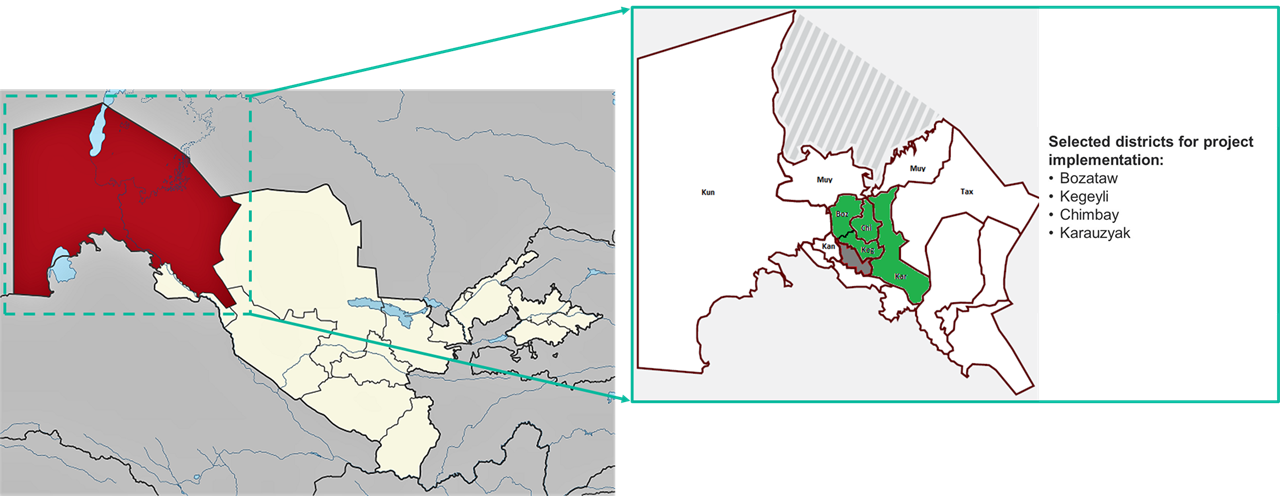
- The project will work with residents of four selected districts involved, among other activities, in the production and processing of agricultural products. Through climate resilient agri-business models, the project will benefit rural farmers, as well as rural and urban entrepreneurs, who have established or are willing to establish MSMEs for production and processing of agricultural produce into value added products. Four disctricts have been selected for project implementation:
Aral Sea GRIP Media Campaign
Click here to explore our playlist of climate-change adaptation awareness-raising videos.
Partners
Resource Partner
Implementation Partners and Steering Committee Members