Browse Knowledge

Sort by
Asian Development Bank (ADB)
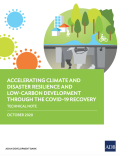
The scale of the COVID-19 crisis and the associated size of the response mean that decisions governments make now will influence systems, create assets, and define development directions well into the future. ADB developed this technical note to help its developing member countries in moving forward, with the assessment framework intended to serve as a tool that decision-makers can use to select and prioritise a package of recovery interventions that will collectively achieve recovery, climate, and resilience objectives.
Smart Prosperity Institute (SPI)
This report aims to kickstart a more holistic discussion on the full suite of public policies needed to support innovation for a circular economy in Canada. It explores these policies through insights from experience with clean innovation, and a review of the emerging global menu of circular economy policies. Based on this analysis, it highlights gaps that need to be addressed and makes the case for building a robust innovation ecosystem to support the circular economy transition.
Organisation :
World Wide Fund For Nature (WWF)
This study is the first comprehensive scientific assessment and material flow analysis of plastic packaging waste in the Philippines. This serves as foundation for the proposed elements and components of an extended producer responsibility (EPR) scheme for the Philippines.
United Nations Environment Programme (UNEP)

As global demand for material resources has increased dramatically in recent decades, rising international trade has become an essential means to overcome the constraints posed by local resource scarcity. While the contribution of international trade in fuelling economic expansion has long been recognised, its impact on the environment is more ambiguous. Trade can prove damaging to the environment by boosting overall resource production and use, shifting production to countries with less-stringent environmental legislation, and increasing energy use and pollution linked to transportation. Yet, when accompanied by appropriate measures, trade can enable and accelerate the transition to a greener, more circular economy – for instance, by facilitating access to green technologies and to other environmental goods and services.

Online
Organisation :
United Nations Environment Programme (UNEP)
United Nations Industrial Development Organization (UNIDO)
United Nations Institute for Training and Research (UNITAR)
What policies can countries implement to address the two defining crises of our time—COVID-19, and the climate emergency? How do we build the next generation of leaders—and those that educate them—needed to advance green, structural change? In seeking to answer both of these questions, PAGE's new e-course and teaching materials could not be timelier.
Online
thisisengineering-raeng-kiVBdtYILQc-unsplash.jpg
Organisation :
United Nations Institute for Training and Research (UNITAR)
The Chemicals and Waste platform, developed by the United Nations Institute for Training and Research (UNITAR), provides a 5 training on chemicals and waste management.
Online
Organisation :
United Nations Environment Programme (UNEP)
The aim of the Life Cycle Management – Capability Maturity Model (LCM-CMM) is to focus on capability development and implementation to fully operationalise and mainstream Life Cycle Assessment in product development, marketing, and strategic decision-making in business.
Online
Organisation :
United Nations Environment Programme (UNEP)
As part of its second key activity area devoted to capacity building, United Nations Environment Program (UNEP) introduces the Life Cycle Initiative is producing several e-learning modules that address life cycle thinking and approaches from different perspectives and in various levels of depth.
Online
Organisation :
World Bank Group (WBG)
From 21 September 2020 to April 2021, the World Bank is holding an online course on "Circular Economy and Private Sector Development: Learning Series".
Science-Based Targets for Nature_SBTN.jpg

The guidance covers the following questions: What is a science-based target? Why are science-based targets important? How will they work?