
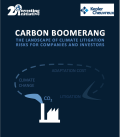
Climate-related litigation risk is the long-term risk that lawsuits targeting companies with high cumulated past emissions create liabilities, based on the company’s share of responsibility in the cost of global warming. It is not limited to direct emissions and likely to occur in countries where extra-territorial jurisdiction and class action lawsuits exist. The tort cost could include adaptation costs at the local level for states and cities (invested by anticipation), thus shortening the time horizon of risk from the years 2050-2100 to today. This concept note focuses on this type of risk.

This toolkit provides comprehensive information on eight different policy areas that states and localities can consider as they work to reduce food waste. The toolkit can be utilized by legislators, advocates, food donors, and food recovery organizations to call for policy changes.
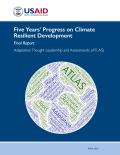
This report outlines ATLAS’ five years’ progress on helping the Agency integrate climate adaptation across its portfolio, building the climate resilience of national partners, and strengthening methodologies to assess and respond to climate impacts in sectors as diverse as health, urban planning, transport and water management.
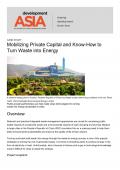
This case study explores how public-private partnerships can help make clean technologies for turning waste into energy accessible to cities.

USAID has developed tools to support climate risk screening and management in strategy, project, and activity design. These tools are meant to improve the effectiveness and sustainability of development interventions by helping the user to assess and address climate risk.
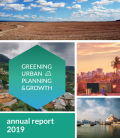
In 2019, GGGI’s work program on green cities included support for green growth plans and policies, green investments, and capacity building activities and knowledge products across 13 countries. This 2019 Annual Report features stories on green cities from Uganda, Myanmar, Cambodia, Fiji, Lao PDR, Mongolia, Peru, the Philippines, and Rwanda.
The Guidebook provides an overview of the process needed for designing and implementing effective monitoring and evaluation (M&E) for Ecosystem-based Adaptation (EbA). It breaks this process down into four key steps that will help you develop and operationalise an M&E system for EbA, as well as effectively use and communicate M&E results.

This podcast discusses whether the impact of COVID-19 affects men and women differently. While coronavirus seems to have a higher fatality rate in men, women may suffer more from the economic fallout from the crisis, be vulnerable to domestic abuse, and have to provide the increased amount of childcare that comes with lockdowns.
This report summarizes the practices that NRDC found to be the top money-saving, environmental protection opportunities in Bangladesh, which largely overlap with the practices identified in China.

This checklist for assessing the sustainability of economic recovery interventions is split into two categories (short-term 6-18 month considerations and long term considerations).