
The Overseas Development Institute, working alongside Gesellschaft für Internationale Zusammenarbeit and the International Poverty Reduction Center in China, have been developing a collaborative, research, policy engagement and knowledge transfer exchange programme. The aim is to provide stakeholders with firm evidence of ways to promote effective investment in green growth. This working paper presents the findings of the programme’s scoping study, conducted in India and China, which sought to identify and better understand drivers for green growth.
The paper begins by outlining the tenets of the green growth paradigm, defining the concept of green growth as being both sustainable and inclusive. It then presents the findings of the scoping study and looks at the evolution of green growth thinking. The authors also explore the potential for sharing lessons learnt, both between India and China and with other countries, and set out a proposal for identifying policy and initiative case studies for further analysis and impact assessment.
The scoping study consisted of:
Bamboo, rattan, seagrass and other raw materials used in handicrafts production are an important part of Viet Nam’s natural capital. These are valuable resources that need to be protected, harvested and utilised in a sustainable manner to ensure a vibrant crafts sector now and for future generations. The environmental impacts of crafts production by households and Micro, Small and Medium Enterprises (MSMEs) are often considered negligible given the scale of their operations, yet taking into account their sheer number, use of natural materials and limited capabilities, their production practices should also be appropriately addressed. Piecemeal interventions just at the production cultivation or stages, will only produce equally limited results. A comprehensive and integrated approach is needed to make green and clean-up the entire value chain, starting from raw materials collection, processing, crafts production and transportation, right up to final markets. Coordinated interventions to make green five value chains were supported in Viet Nam, respectively in the: bamboo and rattan, seagrass, sericulture and silk, lacquerware and handmade paper sectors.
India is expected to grow at such a rapid rate over the next two decades that it could build approximately 80 per cent of the physical assets—including infrastructure, commercial and residential real estate, vehicle stock, and industrial capacity—that will constitute the India of 2030.
Growth of this magnitude will bring tremendous benefits, but it also poses many challenges, particularly regarding sustainability. Demand for resources will increase dramatically, for example, raising the country’s dependence on imports for commodities such as crude oil and driving commodity prices higher in general. And India will need to expand its capacity to generate electricity to meet increasing industrial and residential demand, which will impel a corresponding increase in greenhouse-gas (GHG) emissions.
Renewable energy markets, industries, and policy frameworks have evolved rapidly in recent years. This report provides a comprehensive and timely overview of renewable energy market, industry, investment, and policy developments worldwide. It relies on the most recent data available, provided by a network of more than 500 contributors and researchers from around the world, all of which is brought together by a multi-disciplinary authoring team. The report covers recent developments, current status, and key trends; by design, it does not provide analysis or forecasts.
Many economists and policy makers advocate a fundamental shift towards “green growth” as the new, qualitatively-different growth paradigm, based on enhanced material/resource/energy efficiency and drastic changes in the energy mix. “Green growth” may work well in creating new growth impulses with reduced environmental load and facilitating related technological and structural change. But can it also mitigate climate change at the required scale (i.e. significant, absolute and permanent decline of GHG emissions at global level) and pace? This paper argues that growth, technological, population-expansion and governance constraints as well as some key systemic issues cast a very long shadow on the “green growth” hopes. One should not deceive oneself into believing that such evolutionary (and often reductionist) approach will be sufficient to cope with the complexities of climate change. It may rather give much false hope and excuses to do nothing really fundamental that can bring about a U-turn of global GHG emissions.
The main objective of this paper is the focus on the potential for green growth and outline which policies may enhance the greening of fisheries and aquaculture through the supply chain. The starting point is a discussion of the consequences of not changing the current policies for industries with a major potential for environmental impact. Based on this, the paper discusses the potential for green growth policies. It is important to recognise that while some policies can promote win-win potentials, some policies and strategies may be conflicting.
The paper includes data on Norwegian aquaculture production.

This report looks at potential options for curbing emissions from international aviation. It considers the environmental, economic and political consequences of potential market based mechanisms, and offers an overall assessment of climate policy in this sector.
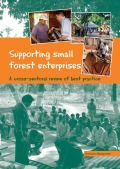
This report reviews the growing consensus on best practice in small enterprise support, both within and outside the forest sector. It describes how a framework known as ‘market system development’ unites attempts to: strengthen enterprise associations, facilitate better provision of financial and business development services, and improve the business environment. It concludes with specific recommendations for support to SMFEs.