
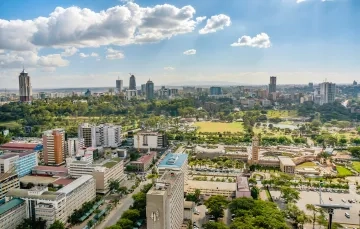
The Global Opportunities for Sustainable Development Goals (GO4SDGs) initiative was launched in the Africa region on 11 May 2021 in a virtual event organized by the United Nations Environment Programme’s Regional Office for Africa. The event brought together high-level participants from the public and private sectors from 35 countries – 24 from Africa – to discuss the acceleration of regional solutions for inclusive green and circular economies, sustainable consumption and production, as well as how to work towards a resilient post-COVID-19 recovery.
Africa’s rapidly growing population is expected to double to 2.5 billion by 2050 with half of the continent’s population living in urban areas by 2035. This, combined with rising per capita consumption, is set to increase pressure on water, land, forests and wood, and biodiversity in the region, which in turn will make attaining responsible consumption and production a challenge. Sustainable Development Goal (SDG) 12 has 11 targets that aim to ensure sustainable consumption and production patterns promote increased human well-being while decoupling economic growth from resource use and environmental degradation.
Delivering on the SDGs
The 2020 Africa SDG Index and Dashboard, published by the Sustainable Development Goals Centre for Africa, showed that African countries were performing comparatively well in terms of SDG 12; however, the lack of data to track progress needs to be improved. The dashboard also indicated that SDG 12 remains generally under-resourced, and that coordinated collaboration and scaling of ongoing implementation efforts are greatly needed.
Frank Turyatunga, Deputy Director and Regional Representative of the UNEP Regional Office for Africa, said at the launch that the GO4SDGs initiative is an important coordination mechanism to help “connect the dots” for resource efficiency, cleaner production and green growth, and to integrate circularity principles to ensure Africa makes progress towards achieving the goals of SDG 12.
“We need to transition from economies that exploit natural resources and generate waste to economies that innovatively exploit waste and nurture resources,” he said.
Henry Kwabena Kokofu, Executive Director of the Ghana Environmental Protection Agency, stressed that the UN SDGs provide a ready pathway for development of Africa in a sustainable manner for all Africans. “The SDGs are about the future that we all want and indeed a future that we all need. It is also the future we want for our youth.”
Supporting African needs
The core goals of the GO4SDGs initiative are to: implement action and change by supporting government efforts to strengthen policy coherence; support small and medium-sized enterprises (SMEs) to increase capacities and access for financing innovation and circularity; and encourage youth to amplify their voices and empower them to embrace sustainable lifestyles.
“About 60% of Africa’s population is less than 25 years of age, and many of the youth are unemployed,” warned David Rubia, Programme Management Officer with the UNEP Regional Office for Africa. “This is a crisis and we need to link sustainable lifestyles with economic empowerment to get the majority of Africans working and doing so sustainably.”
As part of the GO4SDGs launch, a high-level panel discussed how policymakers can best formulate coherent policies on resource efficiency, sustainable consumption and production, and green economies in Africa.
Jenitha Badul, Senior Policy Advisor for Sustainability Programmes and Projects at South Africa’s Department of Forestry, Fisheries and the Environment, said that for there to be coherent policy-setting in Africa, political will is needed from the top coupled with better inter-agency coordination, especially as sustainable consumption and production is a cross-cutting theme on the national agenda. “We also need commitment from industry and labour markets to embrace the changes heralded by sustainable, circular economy policy frameworks,” she added.
Patrick Lumumba, a Senior Capacity Development Officer with the African Guarantee Fund, identified key actions that were needed by financing institutions to address the challenges SMEs face in accessing green financing – high on the list is comprehensive reskilling. “To facilitate sustainable financing to green SMEs, it is imperative to integrate targeted capacity development support so that they are credit/investment-ready and to financial institutions to ensure that they have the right mindset, systems and financial solutions to address the needs of the SMEs,” he said.
Sustainable production and consumption hotspots
Following the GO4SDGs launch, two training module workshops for African policymakers was made available on UNEP’s Sustainable Production and Consumption Hotspot Analysis Tool (SCP-HAT). The tool analyses hotspots in a country or at the sector level where unsustainable consumption and production are happening. Participants learn how to apply this tool to a topic and interpret the results.
SCP-HAT is designed for policymakers, UN country teams, research institutes and other key stakeholders. It will support GO4SDGs’ work on mainstreaming resource efficiency in development and climate change strategies. Each workshop is designed to help participants identify which national-level consumption and production practices can have the greatest effect on mitigating biodiversity impacts and climate change-inducing activities.
A full recording of the event is available here.