
The Global Opportunities for Sustainable Development Goals (GO4SDGs) initiative was launched for Latin America and the Caribbean (LAC) on 17 March 2021 at a high-level event within the framework of the Regional Forum on Sustainable Development.
The GO4SDGs event – organized by ECLAC and co-hosted by the Ministry of Environment and Sustainable Development of Argentina and United Nations Environment Programme (UNEP) – highlighted the importance of sustainable consumption and production for a resilient and inclusive recovery in the LAC region.
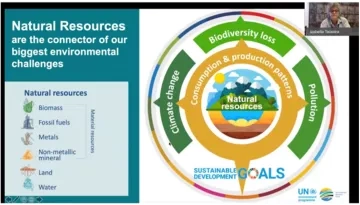
Panelists agreed that unsustainable patterns of consumption and production are putting undue stress on the planet’s resources, threatening not only progress made on the Sustainable Development Goals (SDGs), but also human well-being. These unsustainable patterns are the root cause of three planetary crises: climate change, loss of biodiversity and pollution.
Panelists also stressed that the current pandemic should be a reminder of the importance of protecting biodiversity and the need to increase climate action and social inclusion.
“While overcoming the pandemic, it is essential that mobilized public funds are channeled into sustainable sectors aligned with the 2030 Agenda – ambitious climate action is not a contradiction to economic growth,” said Stephan Contius, Commissioner for the 2030 Agenda, Head of Division United Nations, Developing Countries and Emerging Economies; Federal Ministry for the Environment, Nature Conservation and Nuclear Safety (BMU), Germany.
“The increasing fires and natural disasters in the region show the need and urgency to rethink the way we are doing things,” added Rodrigo Rodríguez Tornquist, Secretary of Climate, Sustainable Development and Innovation, of the Ministry of Environment and Sustainable Development, Argentina. “We need to claim and strengthen the 2030 Agenda and have a dialogue for a sustainable recovery with the social agenda at the heart.”
According to the International Resource Panel (IRP), resource extraction and processing of material fuels and food is responsible for 50% of global climate change impacts and 90% of biodiversity loss and water stress. Countries are becoming more efficient, but global productivity has not improved in the last years. Moreover, the use of natural resources and its benefits and environmental impacts are unevenly distributed across countries. In the last 50 years, domestic material consumption has not changed for low-income countries despite needing it the most.
“We need to address climate change, biodiversity loss and pollution, but also renew our commitments to the environment and social agenda,” said Izabella Teixeira, Co-Chair of the International Resource Panel.
During the event, it was stressed the need to change consumption and production patterns and promote a circular economy, decarbonization and dematerialization. Some examples indicate that 60% of lifecycle emissions can be reduced through material efficiency strategies.
Mariano Castro, Vice-Minister of Environmental Management of Peru, highlighted the important role of GO4SDGs to promote more coherent policies bringing together initiatives on inclusive green economies, sustainable consumption and production, and the circular economy. He highlighted the need to connect with national agendas, as well as with commitments outlined in the Paris Agreement and the Escazú Regional Agreement.
Jose Luis Samaniego, Director, Division of Sustainable Development and Human Settlement, ECLAC, said that the extractive industries in the LAC region do not contribute significantly to GDP or employment. This reinforces the need to diversify the economy. As such, he said that the circular economy needs to be mainstreamed in the economic sector, to make it more sustainable and inclusive with a lower carbon impact.
Leo Heileman, Regional Director and Representative, UNEP, who moderated the panel, indicated that the GO4SDGs responds to the Mandate of the Regional Forum of Ministers of Environment and its Decision on sustainable consumption and production and circular economy – key drivers for post COVID-19 sustainable recovery. He added that countries welcome GO4SDGS as a platform to accelerate action and to scale up and replicate regional solutions and to promote more policy coherence.
Adriana Zacarias, Head of GO4SDGs, presented the main objectives of the GO4SDGS initiative and activities planned in the LAC region. This includes mainstreaming the benefits of resource efficiency and sustainable consumption and production for climate policies and economic recovery, exploring mechanisms for financing circularity and innovation, and empowering youth for sustainable and low-carbon lifestyles.
A second panel – “A food system approach to address food waste” – was organized on 18 March, with participation of representatives from Costa Rica, WRAP, the UN Food and Agriculture Organization (FAO), World Wide Fund for Nature (WWF) and Inter-American Development Bank (IDB). During the panel, a call for expressions of interest was launched to convene regional working groups to provide capacity building on the measurement and reduction of food waste. UNEP and WRAP will facilitate a series of workshops to help governments and relevant partners develop baselines for reporting on SDG 12.3 on food loss and waste in 2022 and national food waste prevention strategies. This work will be important to address climate change and protect biodiversity. Learn more.
A full recording of the launching event is available in Spanish: