
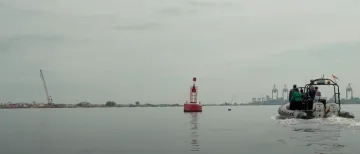
Marine transportation is a vital part of Indonesia’s way of life, being a nation comprised of more than 17,000 islands. The Port of Tanjung Priok (Pelabuhan Tanjung Priok), lying at the mouth of River Ciliwung on Jakarta Bay, handles more than 50% of Indonesia's trans-shipment cargo traffic.
Guarding the shipping lanes are a network of lighthouses and, in greater number, navigation buoys. These small floating devices have an outsized impact. Buffeted year-round by wind and sea, crusted with salt, garlanded by shorebirds and festooned with scurrying crabs, the stolid buoys guarding Jakarta Harbour are essential equipment for safe navigation at sea and in port.
The buoys host navigation beacon lights which flash, guiding ships traveling at night or in foul weather. They help provide ships with warning of danger, so as to avoid the occurrence of accidents or lost load.
On a breezy morning in late November last year, we set out in Coast Guard pontoon boats from the Navigation District Office Tanjung Priok (Kantor Distrik Navigasi tanjung Priok) to view up close the anchored floating devices which serve to safely guide navigation in Jakarta Bay.
The Government of Indonesia’s Sea Navigation Authority at the Ministry of Transport has embarked on a pilot programme to install solar photovoltaic (PV) panels to power the navigation buoys, replacing those fueled by petroleum.
The Marine Navigation Authority is enthusiastic about the new solar technology. It is also introducing solar powered lighthouses. The substitution of solar power lowers the greenhouse gas emissions of these marine safety structures.
The Indonesian Ministry of Transportation viewed the solar installations as part of its fulfilment of the Government of Indonesia’s commitment to meet greenhouse gas emission reduction targets set by the Paris Agreement and Sustainable Development Goals.
In 2017, the Government of Indonesia had launched the Low Carbon Development Initiative (LCDI) – a non-siloed approach to achieve low-carbon development, sustainable natural resource management and poverty alleviation while maintaining economic growth (PAGE 2021). As it prepared to assume the Presidency of the G20 on 1 December 2022, Minister of Energy and Mineral Resources, Arifin Tasrif, called for an accelerated energy transition as the ‘lighthouse deliverable’ of Indonesia’s presidency. Indonesia has pledged that the country will reach its carbon neutral target by 2060 “or sooner with real support from the international community” (Wood MacKenzie 2021). The government also made commitments to reduce the use of coal and oil and move towards sustainable energy sources in their Enhanced Nationally Determined Contribution (NDC) of 2022.
In the energy sector, Indonesia has established the development of clean energy sources through a national policy directive. Presidential Regulation No. 22/2017 on the National Energy Grand Plan mandates the target of 23% New Renewable Energy in the national energy mix by 2025. Energy efficiency measures to be carried out by all energy consuming sectors (industry, commercial, transport, residential) through improvement of device efficiency and energy system efficiency are predicted to bring 15,483 MW of Renewable Energy by 2030. Longer-term to 2050, the power sector sees a radical transformation with over 1,000 GW of renewable capacity or more required.
The contribution of solar powered navigation buoys and lighthouses is small yet consistent with the national goals to put Indonesia on the path to decarbonisation. Backing that contribution are measures to ensure sustainable resources, including international finance, are successful raised to ensure adequate investment in renewable energy and low-carbon transportation is achieved.
In 2019, Indonesia estimated its needs approximately US$322.86 billion for the implementation of mitigation actions in the NDC roadmap. Indonesia has developed a number of innovative green financing instruments, which may contribute positively to NDC implementation.
“Across the UN system, agencies are working increasingly on trying to think how do we mobilize private and public finance for their specific SDGs and other development partners as well,” said Sujala Pant, UNDP Deputy Resident Representative, Indonesia. “[T]here‘s a real need for the UN system to better coordinate the delivery of sustainable finance to... governments in the region.”
The Climate Budget Tagging (CBT) process has been developed and implemented since 2014 with the support from UNDP, though the Sustainable Development Finance Project. CBT is an effective tool for tracking expenditures on climate change actions and for improving budget efficiency, transparency and accountability.
The joint project of UNDP and UNEP, Poverty-Environment Initiative (PEI) supported government efforts to develop and implement climate budget tagging and the use of performance-based budgeting. It involves a detailed assessment of the climate benefits of projects undertaken by line ministries. Since 2018, climate budget tagging has expanded to include line ministries related to climate change adaptation action plans, reaching 17 ministries/institutions across adaptation and mitigation activities.
Most significantly, climate budget tagging is being used to support those investments which qualify as so-called Green Bond/Green Sukuk (Islamic Bond) investments, under a Green Sukuk Framework developed in 2018. Green Sukuk is an innovative financial instrument designed to support Indonesia’s commitment in greenhouse gas emissions reduction based on Islamic Law principles.
In March 2018, the Government of Indonesia, through the Ministry of Finance, issued the very first sovereign Green Sukuk, raising US$1.25 billion. The five-year issuance successfully reached a broad range of conventional, Islamic and green investors. All proceeds went exclusively to selected ‘eligible green projects’ based on the Green Bond and Green Sukuk Framework.
The Government of Indonesia issued its fourth global green sukuk amounting to $750 million in June 2021, followed by issuance of a retail green sukuk amounting to IDR 5 trillion (about $347.1 million) in November 2021. The total amount of Global Green Sukuk issuance by June 2022 reached USD 5.8 billion (Refinitiv et al. 2022). Indonesia comprised 27% of this total.
Among the projects financed by the first Green Sukuk Issuance was installation of the solar power navigation buoys and lighthouses in Jakarta Bay.
A second Green Sukuk issuance in 2019 funded another Ministry of Transportation-backed initiative, the Double Track Railway Project in North Java Line Double track railway from Jakarta to Surabaya (727 km). The double track is currently being installed at Manggarai Station, Jakarta’s main central railway line slated to become the terminus for most intercity trains in 2025. Increasing the capacity of rail transport in and out of Jakarta Metropolitan Area (Jabotabek), whose population is estimated to exceed 31.5 million, mitigates transportation’s impact on energy consumption and carbon emissions. Investment in urban mass transport is therefore one of the national strategic priorities (Republic of Indonesia 2020).
Support for the Climate Budget Tagging process and Green Sukuk was extended by UNDP-UNEP Poverty-Environment Action for Sustainable Development Goals under a technical assistance project initiated as the successor to Poverty-Environment Initiative in 2018. Through the Sustainable Development Finance Project, Poverty-Environment Action continued to support the country‘s Green Sukuk initiatives by building capacity among Government officials to employ climate and gender-sensitive budget tagging methodologies.
The payoff from these measures for Indonesia in reduction of carbon emissions is clear. The total projected greenhouse gas emission reduction in Indonesia from Global Green Sukuk funded projects reached 10.3 Mt CO2e by 2019.
From marine navigation safety to sustainable urban transport, in ways small and large, Indonesia has taken up the cudgels for sustainable development and climate action. The success of Poverty-Environment Initiative and Poverty-Environment Action’s pioneering work shines a beacon of hope on the future of sustainable development for the people of Indonesia.
References
IRENA (2022). Indonesia energy transition outlook, International Renewable Energy Agency, Abu Dhabi.
McLeod, I., Ringwood, J.V. (2022), Powering data buoys using wave energy: a review of possibilities. J. Ocean Eng. Mar. Energy 8, 417–432.
Ministry of Economic Affairs, Republic of Indonesia (2019). JABODETABEK Urban Transportation Policy Integration Project Phase 2 in the Republic of Indonesia, Annex 02: JABODETABEK Urban Transportation Master Plan. October 2019.
Partnership for Action on Green Economy (PAGE) (2021). 2021 Annual Report - Indonesia.
Refinitiv, Islamic Finance Council UK (UKIFC) and Global Ethical Finance Initiative (2022). Financing a Sustainable Future: Green and sustainable sukuk report 2022.
Republic of Indonesia (2020). National Medium-Term National Development Plan 2020-2024.
Republic of Indonesia (2022). Enhanced Nationally Determined Contribution Republic of Indonesia.
Stibniati S. Atmadja, Nining Liswanti, Ade Tamara, Hias inta Lestari and Houria Djoudi (2021). Leveraging Climate Finance for Gender Equality and Poverty Reduction. CIFOR and UNDP.
Wood MacKenzie (2022). “Indonesia’s G20 presidency and the ‘lighthouse deliverable’” (21 October 2022). https://www.woodmac.com/news/opinion/indonesias-g20-presidency-and-the-lighthouse-deliverable/, accessed on 20 February 2022.