
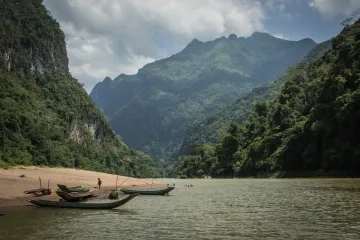
Lao People’s Democratic Republic (PDR) is a land rich in natural resources. How best to marshal these resources to promote sustainable development and poverty reduction lies at the heart of Poverty-Environment Action, the four-year project launched in 2018 by the Government of Lao PDR with the support of United Nations Development Programme (UNDP) and United Nations Environment Programme (UNEP). At its conclusion in December 2022, an ambitious set of measures and tools had been set in place to make investment in natural resources work for the people of Lao PDR.
The Government of Lao PDR has made efforts to prioritize investments in natural resource sectors that can directly and indirectly aid poverty reduction. However, Lao PDR's historic reliance on resource-based development has often limited the positive impact of economic growth on poverty reduction. Moreover, this pattern of development has also led to significant environmental degradation, putting the country's biodiversity and natural resources at risk.
Foreign Direct Investment (FDI) in Lao PRD has generally targeted natural resources, specifically, the mining, hydro power and agriculture sub-sectors (UNDP 2018). Foreign investments account for more than 50 per cent of gross domestic product (GDP), but they also raise serious social and environmental issues. Unregulated investing led to cases of village displacement, land grabbing or segregation of resources vital to the livelihood of inhabitants, without necessarily contributing to the country’s development (UNEP 2019).
We can illustrate this with the case of deforestation. The percentage of land area covered by forests in Lao PDR decreased from 77.3 per cent in 1990 to 71.9 per cent by 2020, a seven per cent decline.1 Factors that have influenced forest decline derive mostly from economic activities, such as forest land conversion for agriculture, mostly cash crops, and urban sprawl associated with infrastructure expansion and hydropower production.
FDI into hydropower, mining, and large-scale agribusinesses lead to fierce competition over land, with local people being evicted from their villages and land (Messerli et al. 2015). In one dramatic case, 25 villages were displaced due to a land concession to a Vietnamese rubber company. Local communities were prevented from accessing the natural resources upon which they based their livelihood.
At the invitation of the Government of Lao People’s Democratic Republic, the joint UNDP‒UNEP Poverty-Environment Initiative (PEI) supported the government from 2009 to 2018 in developing tools to guide promotion, screening, approval, monitoring and compliance enforcement of investments. PEI further helped build the capacity of institutions to engage with impacted communities and recognize unintended social and environmental impacts of investments in key natural resource sectors.
The project developed the “PEI Approach” which addresses poverty reduction and environmental protection by supporting the Government’s national socio-economic planning and strategy formulation processes. The Poverty-Environment Initiative country team worked closely on implementing poverty-environment objectives in policy, planning and programmes with the Lao PDR National Assembly, the Ministry of Planning and Investment, the Department of Environment and Social Impact Assessment, the Ministry of Natural Resources and Environment, the Investment Promotion Department and the National Economic Research Institute.
With the support of PEI, Lao PDR was able to upgrade its legal framework and safety net to bind investments to more equitable conditions. The 7th Five-Year National Socio-Economic Development Plan (2011- 2015) and 8th Five-Year National Socio-Economic Development Plan (2016-2020) saw poverty-environment issues integrated and highlighted the objectives of quality growth and equity.
The programme also focused on building investment regulatory tools and the knowledge to assess, measure and enforce financial, social and environmental obligations of investors. Another aspect also included strengthening Lao PDR’s National Assembly’s ability to deliver their constitutional oversight role on quality investments.
Improved assessments and investment data management had begun to inform decision-making and create understanding of whether investments were economically beneficial for communities, at the time of the conclusion of the PEI project in Lao PDR in 2018.
Aware of the ongoing demand and unaddressed challenges of poverty-environment mainstreaming and integration in developing countries, UNDP and UNEP had already begun preparing a successor project to PEI in early 2017. Rather than a continuation of PEI, the new project would focus on quality green investment and sustainable finance.
The joint UNDP‒UNEP project, Poverty-Environment Action for Sustainable Development Goals (Poverty-Environment Action), the successor of PEI, operated from 2018 to 2022 in partnership with the Lao PDR Investment Promotion Department (IPD) of the Ministry of Planning and Investment. Entitled “Improving Quality Investment for Achieving Sustainable Development Goals in Lao PDR”, the new project aimed to strengthen coordination of government’s regulatory capacity to coordinate and promote higher quality investment to contribute to the SDGs. This was done through promoting and monitoring quality and responsible investment planning for sustainable development, by strengthening assessments, regulations, approvals and inspections. Improvement in the ease-of-doing business; and transparency, accountability, and effectiveness of investment management were also targeted.
The 9th National Socio-Economic Development Plan (NSEDP 2021-2025), which was endorsed by the National Assembly in March 2021, puts the emphasis on green growth and quality investment. Under Poverty-Environment Action, the project team prepared Quality Investment Appraisal Guidelines to incorporate the green growth criteria into private investment appraisal process. The Guidelines introduce the checklist for the evaluation of investment proposals that are in line with the National Green Growth Strategy and good international practices in the area of Green Growth.
In 2022, Poverty-Environment Action reviewed the Provincial Investment Strategy (PIS) and PIS implementation report to provide recommendations for future PIS reporting and monitoring with linkages to investment profiling. Poverty-Environment Action reviewed and finalized the contents of investment profiles from seven provinces, enhancing 32 profiles to incorporate green and responsible investment aspects before their finalization and publication in 2022. Prioritized sectors were identified to attract more qualified investors to develop high value products and services. These measures have further disseminated the PEI/Poverty-Environment Action approach across sectors and at provincial level.
By September 2022, IPD had entered 123 concession and control businesses into the national Database. Poverty-Environment Action has organized training on database management of the Investment Database for 20 IPD officials and officers from many provincial authorities; the database is now installed in IPD’s server. The Investment Database currently features the capacity to produce reports on the status of (non) compliance pending feed-ins of monitoring related information collected during monitoring missions.
Sustained economic growth will be necessary to enable Lao PDR to graduate to middle-income status, a goal of the country’s 9th NSEDP. This will require continued levels of FDI, particularly in the natural resource sector, to sustain an annual growth in GDP of at least 7.5 per cent (World Bank, 2020). Growth alone, however, will not address poverty and may exacerbate development challenges, widen inequality and entrench poverty. Furthermore, the natural resource sector is particularly vulnerable to environmental risks and challenges, such as deforestation, biodiversity loss, and climate change. Overreliance on natural resource extraction for economic growth may exacerbate these challenges, putting the country's natural resources and the livelihoods of local communities at risk.
The foundation laid during the Poverty-Environment Initiative (2009-2018) provided the structure upon which Poverty-Environment Action for Sustainable Development Goals (2018-2022) could build a solid basis to promote sustainable investment in natural resources.
Going forward, Lao PDR is expected to officially endorse the 9th NSEDP Financing Strategy in the first half of 2023. The advanced draft, validated in September 2022, includes 54 concrete actions to sustainably finance the objectives of the 9th National Plan in the context of economic and fiscal difficulties in Lao PDR. Ensuring quality FDI through adequate risk assessment tools and strengthened institutional review is a critical aspect of the Financing Strategy, including its priority policy area on “Green and Climate Finance” (Ministry of Planning and Investment, Lao PDR, 2023).
The practices pioneered by PEI and Poverty-Environment Action and adopted by the Government of Lao PDR can, if pursued vigorously, contribute to the implementation of the 9th NSEDP Financing Strategy and lead to economic benefits being more fairly distributed among local communities, bringing the promise of all three dimensions of sustainable development – economic, social and environmental – closer to achievement.
1 World Bank Databank, Forest area (% of land area) - Lao PDR (citing FAO). Accessed on 18 February 2023, https://data.worldbank.org/indicator/AG.LND.FRST.ZS?locations=LA
References
Global Witness (2013). Rubber Barons: How Vietnamese Companies and International Financiers are Driving a Land Grabbing Crisis in Cambodia and Laos.
Messerli P, Bader C, Hett C, Epprecht M, Heinimann A (2015). Towards a Spatial Understanding of Trade-Offs in Sustainable Development: A Meso-Scale Analysis of the Nexus between Land Use, Poverty, and Environment in the Lao PDR. PLoS ONE 10(7): e0133418.
Ministry of Planning and Investment, Lao PDR, and UNDP (2022). National Human Development Report LAO PDR 2022 Report Brief.
Ministry of Planning and Investment, Lao PDR (2023). 9th National Socio-Economic Development Plan Financing Strategy 2023-2025 (advanced draft). https://rtm.org.la/wp-content/uploads/2023/01/Advanced_draft_FS_clean_with_exec_summary_DOP-_24_01.pdf
Schönweger, Oliver et al. (2012). Concessions and leases in the lao PDR: Taking stock of land investments. Bern: Geographica Bernensia
UNDP (2018). Improving Quality Investment for Achieving the Sustainable Development Goals in Lao PDR. Project document 00113551/00116379.
UNDP – UN Environment (UNEP) (2021). Poverty-Environment Action for Sustainable Development Goals (Poverty-Environment Action-PEA) Project Mid-term Review.
United Nations Development Programme and United Nations Environment Programme (2013). Stories of Change from the Joint UNDP-UNEP Poverty-Environment Initiative. Nairobi.
UN Environment [Programme] (2019). Global Environment Outlook – GEO-6: Healthy Planet, Healthy People. Nairobi, pp. 378-380.
World Bank (2020). Poverty Profile in Lao PDR and Poverty Assessment 2020: Catching Up and Falling Behind.