
Malawi remains a country challenged by poverty. The proportion of Malawians living on less than $1.90 a day was 73 per cent in 2020, the second highest rate among the poorest countries of Sub-Saharan Africa. Agriculture is overwhelmingly the main economic activity of poor households (World Bank 2022). The vast majority (94 per cent) of poor Malawians live in rural areas and are among those hardest hit by climate shocks. The most recent disaster to devastate Malawi, Cyclone Freddy, one of the most powerful storms ever recorded in the southern hemisphere, killed hundreds and displaced 20,000 people (BBC 2023).
Women-led farms in particular struggle. Female productivity in agriculture is lower than that of men, mainly due to differences in the use of inputs, such as fertilizers and seed stocks, irrigation water, mechanized equipment. The smaller size of land women have access to also contributes to their lower productivity.
In devising a programme to address Malawi’s deeply entrenched poverty and dire environmental and natural resource management needs, United Nations agencies banded together in 2014 under Poverty-Environment Initiative (PEI), a joint project led by United Nations Development Programme (UNDP) and United Nations Environment Programme (UNEP), with the participation of the Food and Agriculture Organization of the United Nations (FAO) and UN Women. PEI was succeeded in 2018 by UNDP‒UNEP Poverty-Environment Action for Sustainable Development Goals, a four-year project which delivered technical advice, advocacy and knowledge products for the environment, natural resource and related sectors.
Poverty-Environment Action Malawi sought to foster integration of environmental sustainability and climate objectives in development planning, budgeting and monitoring systems; and incentivize shifts in public and private investments towards environmental sustainability and climate objectives for poverty eradication.
The new project, which operated from September 2018 to December 2022, focused on leveraging agricultural production and gender equality to build resilience of households to shocks and to address food security and poverty alleviation. Implementation was spearheaded by the Department of Economic Planning and Development in the Ministry of Economic Planning and Development (MoFEPD), Malawi Government’s main agency responsible for national economic and development planning, monitoring and evaluation of socio-economic issues (FAO, UNDP‒UNEP and UN Women 2020).
During a visit to Malawi undertaken in October 2022, organized by United Nations Institute for Training and Research (UNITAR), UNDP Malawi introduced our team to the main tools used to build support for Poverty-Environment Action, with a special focus on agricultural and gender reforms.
UNDP Malawi in collaboration with UNEP, FAO, UN Women, and the Malawi Government have developed three seminal reports and policy briefs through the Poverty-Environment Action Malawi project:
The Climate Smart Aquaculture Toolkit, is a response to the Ecosystem-based Approach to Fisheries and Aquaculture. The toolkit takes into consideration the current and future aquaculture landscape to promote sustainable fisheries management and commercial production (FAO, UNDP‒UNEP and UN Women 2020).
The Soil Loss Mitigation Action Plan and Strategy and the companion Policy Brief, Route to Sustainable Land Management in Malawi: Soil Conservation and Restoration, highlight opportunities for addressing soil and nutrient losses issues in Malawi.
Soil loss can disrupt the natural soil balance and lower the productive potential of agricultural land. Consequences include a decrease in crop yields, loss in farmers’ incomes and profit, reduction in crop and livestock farming activities, decrease in the value of the agricultural land, pollution and destruction of water resources, and migration of rural populations to urban areas. Direct costs of soil loss are significant and range between 0.6-2.1 per cent of the GDP of Malawi.
As with many other environment and natural resource challenges, the impact of soil loss falls disproportionately on women. The impact of soil loss on female headed households is more than double that of a male-headed households. Sustainability solutions are available, however. The highest economic mitigation impact results from the adoption of vetiver grass, followed by terraces, tree belts and bunds (FAO, UNDP-UNEP Poverty-Environment Initiative, and UN Women 2018).
The Cost-Benefit Analysis of the ADAPT PLAN report and policy brief demonstrate the efficiency and impact of various climate adaptation interventions on community livelihoods, environment and natural resources. The report‘s findings can be used to inform the formulation or revision of guidelines for formulating and executing community-based environment and natural resource management projects to ensure that interventions deliver best value for money.
“The report has been well applied in a number of instances, one of the bases, that brought joint implementaton betweeen UN Women, FAO and UNDP‒UNEP [Poverty-Environment Action],” said Linda Chinangwa, Poverty-Environment Action Malawi Project Manager, UNDP.
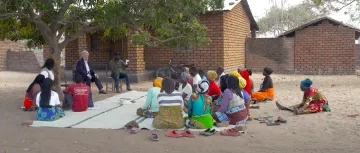
The findings of the report helped build the case for strengthening support for women-led cooperatives, such as the Sululu Horticultural Cooperative which we visited in Salima.
In Salima and other cooperatives, “we have provided capacity in business development management, because we believe that farming is a business...which encourages all members of the household to work together, to plan together, so they have coordinated efforts to ensure they have one voice, which would eventually lead to improved farming,” explained Thandiwe Bwanamdoko, Programme Associate with the Women's Economic Empowerment Portfolio at UN Women.
With support from the Ministry of Agricuture Extension Office, Poverty-Environment Action Malawi and private sectors donors, the Sululu cooperative has built three greenhouses, increasing crop yields. The cooperative, which also includes male members, dreams of acquiring a truck to help them bring their produce to market.
“We have gained a lot of skills on how to farm. Joining this cooperative has helped me,” Ms. Isha Inani, the Cooperative’s youngest member, told us during our visit.
“My family is eating three times a day [and] are happy. Whatever I am earning here is helping the family at home. I work in the morning [at the cooperative], in the afternoon I go to school,” she said with evident pride.
The Cost-Benefit Analysis was adopted and endorsed by policy makers in the National Steering Committee on Climate Change in July 2021. In 2022, a consultancy was commissioned to develop community training modules based on the themes and findings from the cost-benefit report. The development of integrated livelihood and natural resources management training manual will be used in building capacity of communities in implementing community based environment and natural resource management projects for sustainable livelihoods.
Poverty-Environment Action Malawi presented recommendations from the Climate Smart Aquaculture Toolkit, National Soil Conservation Action Plan and Strategy, Payment for Ecosystems Framework and the Cost-Benefit Analysis reports to the Ministry of Agriculture in 2022. The reports will be distributed widely through the country’s agricultural extension services.
References
British Broadcasting Corporation (BBC). Storm Freddy: Malawi declares state of disaster as more than 200 killed“. 15 March 2023. https://www.bbc.com/news/world-africa-64938811 downloaded on 20 March 2023.
Food and Agriculture Organization of the United Nations (FAO), UNDP‒UNEP Poverty-Environment Initiative and the Ministry of Agriculture, Irrigation and Water Development, Malawi (2018). Soil and nutrients loss in Malawi: an economic assessment.
Government of Malawi (2014). Study on overcoming poverty in Malawi through sustainable pathways. Ministry of Finance, Economic Planning and Development. Lilongwe.
Ministry of Economic Planning, Development and Public Sector Reforms, Malawi, Food and Agriculture Organization of the United Nations (FAO), United Nations Development Programme (UNDP)‒United Nations Environment Programme (UNEP), and UN Women (2018). Route to Sustainable Land Management in Malawi: Soil Conservation and Restoration. Lelongwe.
Ministry of Economic Planning, Development and Public Sector Reforms, Malawi, Food and Agriculture Organization of the United Nations (FAO), United Nations Development Programme (UNDP)‒United Nations Environment Programme (UNEP), and UN Women (2018). A Cost-Benefit Analysis of Climate Adaptation Options Supported by the Adapt Plan Project. Policy Brief. Lelongwe.
Food and Agriculture Organization of the United Nations (FAO), United Nations Development Programme (UNDP)‒United Nations Environment Programme (UNEP), and UN Women (2020). Developing A Climate Smart Aquaculture Toolkit: A Synthesis Report for Policymakers and Investors.
Malawi Government (2017). Malawi Growth and Development Strategy (MGDS) III. 23 September 2017. Lelongwe.
National Planning Commission, Malawi (2021). Malawi’s Vision: An Inclusively Wealthy and Self-reliant Nation Malawi 2063. Lelonwe.
Ministry of Agriculture, Irrigation and Water Development, Malawi (2016). National Agricultural Policy. September 2016. Lilongwe.
United Nations Development Programme (UNDP) (2022). Poverty-Environment Action – Malawi. 20 September 2022. https://www.undp.org/malawi/news/poverty-environment-action-pea, accessed on 24 February 2023.
United Nations Development Programme–UN Environment [Programme] (2019). Reward and Renewal: UNDP–UN Environment Poverty-Environment Initiative Phase 2 Final Progress Report 2014–2018. Nairobi.
World Bank (2016). Malawi Poverty and Vulnerability Assessment: Investing in our future. Lilongwe.
World Bank (2022). Malawi Poverty Assessment: Poverty Persistence in Malawi – Climate Shocks, Low Agricultural Productivity, and Slow Structural Transformation.