
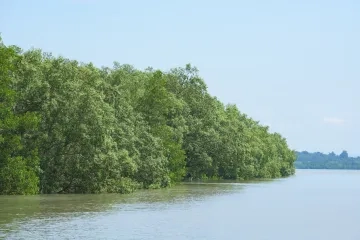
The 3Returns Framework not only accounts for economic benefits, but also considers environmental, human and social capital when it comes to investing in mangrove forest restoration in the Ayeyawardy Delta.
In Myanmar’s Ayeyarwady Delta, mangroves play a vital role for the coastal communities, where 73% of the people are landless and dependent on them as a source for fuel, food and coastal protection from extreme weather conditions. As a result, the mangroves have been exposed to overexploitation, land conversion and illegal logging activities. This poses a fundamental challenge for the communities to secure a stable income. It also increases their vulnerability to natural disasters as reduced mangroves means less protection from extreme storms.
“Mangrove forests make habitats for the marine life, forest products and non-timber forest products, protect soil erosion, natural disasters and give many benefits to tourism industry,” said U Hka Maung Thein, Director of the General Environmental Conservation Department in Myanmar. “But mangrove forests have been gradually degraded due to over exploitation and agricultural expansion. Conservation of mangroves is a national responsibility.”
Landscape conservation and restoration, however, require substantial investment which can often only be justified if the financial returns are clearly known.
To address these challenges, the Global Green Growth Institute (GGGI), in partnership with the Green Growth Knowledge Partnership (GGKP) and the University of Queensland (UQ), conducted an Economic Appraisal of Ayeyarwady Mangrove Forests, aimed at integrating natural capital into investment decisions by improving management of the mangroves.
To estimate the return on investment for the restoration and improved management of mangroves, the 3Returns Framework was developed. This method not only accounts for financial or “physical capital” benefits, but also enables a more holistic approach that considers returns to natural, human and social capital. The goal is to present a greener and more sustainable alternative that enhances local well-being through the identification of monetary and non-monetary benefits.
“The 3Returns Framework aims to strongly contribute to the fundamentals of green growth landscape assessments”, said Juan José Robalino, Value Chain Analyst and Project Lead at GGGI.
Integration of natural capital to green growth policy has been one of the top priorities of the GGKP’s Natural Capital Expert Group.
Benjamin Simmons, Head of the GGKP Secretariat, highlighted the importance of developing and mainstreaming such a framework in the context of green growth. “For too long, the contributions of nature to the economy have been hidden in mainstream economic indicators like GDP,” he said. “The GGKP and its Economics for Nature partners are committed to uncovering and highlighting the full value of natural capital to the green economy. With the 3Returns Framework, GGGI is leading the charge in demonstrating how natural capital can put countries back on a green growth pathway in the post-COVID-19 recovery.”
By using the framework, the project proposes greener scenarios in comparison to business-as-usual scenarios. Results show that investment in mangrove restoration yields higher levels of benefits in the long term. Improved and decentralized mangrove management further increases the total net present value (NPV) of resources in the landscape – between 2019 to 2026, values increase from $275 million in the business-as-usual scenario to $329 million in the most preferred green growth scenario. Conversely, the return on investment (ROI) for business as usual declines over time, reflecting the decrease on benefits due to limited and insufficient replenishment of key capitals and continued overexploitation.
The project highlights how pursuing green growth solutions can bring more sustainable and even longer-term benefits for communities by revealing non-monetary benefits such as increased cumulative biomass carbon sequestration, number of green jobs and species biodiversity.
“We have created a framework that connects, builds on and puts into operation already existing capital accounting frameworks, tools for valuing ecosystem services, and different approaches for evaluating project impacts,” Robalino added. “However, what makes the 3Returns different from other frameworks is the way capitals are interconnected and analysed, which facilitates decision-making towards green growth as successfully demonstrated by our pilot assessment.”
According to U Hka Maung Thein, the assessment was consistent with the objective of analysing policy interventions that support the investment for mangrove restoration, which also reflects Myanmar’s NDC commitments to meet the Paris Agreement goals.
The method also demonstrates how natural capital can be mainstreamed at the institutional level through in-country application cases. The 3Returns Framework is being analysed to be incorporated as a guideline for analysing landscape related projects and programmes in different countries that GGGI is currently working. It has also contributed to the mechanisms for assessing the economic, environmental and social feasibility of potential interventions in GGGI’s sustainable landscapes projects.
The 3Returns Framework report provides stakeholders with a step-by-step guide for landscape assessment, making it feasible for scaling up and replication of the project. The success of the pilot case in Myanmar has already gained attention from multiple government agencies and policymakers, as well as the World Bank, which has expressed interest in scaling up the project in the country.
***
About the GGKP Natural Capital Expert Group
The GGKP Natural Capital Expert Group explores state-of-the-art methods, models, data and tools to achieve its three goals of pushing forward the knowledge frontier around natural capital and green growth, mainstreaming natural capital in global green growth activities, and supporting stronger implementation of natural capital commitments in national economic plans. The group is comprised of senior experts from across GGKP’s partner institutions. For more information, see About the Natural Capital Expert Group.
Economics for Nature
The GGKP Natural Capital Expert Group was established in the context of the Economics for Nature (E4N) programme, a six-year initiative focused on ensuring that nature has a voice in economic and planning processes. The GGKP is part of the core team alongside the Green Economy Coalition (GEC), Capitals Coalition and WWF France.
MAVA Foundation
The MAVA Foundation, a Swiss-based philanthropic organization, has made the mainstreaming of natural capital into national development plans a key focus of its strategic programme for 2017-2022. It has committed to supporting the GGKP Natural Capital Expert Group for six years.