
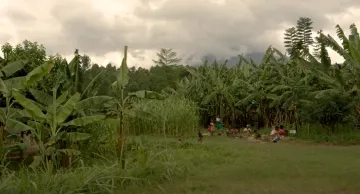
“Land, politics, environment, people’s well-being, they come together in a cocktail that is challenging our current thinking about how people relate to environment and how environment and poverty are linked. And perhaps nowhere in the world has this been more visible than in the recent history of Rwanda,” said Maxwell Gomera, United Nations Development Programme (UNDP) Resident Representative in Rwanda during our conversation held in Kigali in May 2022.
In a United Nations Environment Programme (UNEP) organzied visit, joined by the the United Nations Institute for Training and Research (UNITAR), we came to Rwanda to document the impact of the Poverty-Environment Action for Sustainable Development Goals (2018-2022), the successor to the joint UNDP—UNEP Poverty-Environment Initiative Rwanda (PEI Rwanda), which initially had been launched in 2005.
What would be the legacy of 18 years of United Nations support to Rwanda’s efforts to achieve sustainable development from these two pioneering projects?, we asked government officials, United Nations representatives and community stakeholders. With the impending closure of Poverty-Environment Action in December 2022, how would Rwanda continue its efforts to integrate poverty-environment and climate objectives into national and district policies, or do so with as much success as it had had through the long-term efforts of PEI and Poverty-Environment Action?
Rwanda’s predominantly poor, rural population depends highly on rain-fed agriculture. The natural resources – soils, water, forests – that Rwandan smallholder farmers depend on are under increasing pressure from unsustainable use, soil erosion, deforestation and the impact of accelerating climate change.
To support the growing demand for land and resouces, critical watersheds and water catchments have been converted to agricultural land, with consequences known to impair vital ecosystems. Soil erosion has increased by 54% since 1990 (NISR 2019). Increased runoff linked to greater soil erosion and soil loss poses significant problems that threaten the country‘s food security.
To help the Government address these interlinked issues and promote sustainable development, UNDP, UNEP and the Government of Rwanda began PEI Rwanda as a pilot country project in 2005 and as a PEI full-country project in 2008.
“Rwanda is a natural-[resource] based economy country, meaning it can only develop if its natural resources are sustainably managed. So there was a need to link the two, how to link environmental management [and] at the same time reduce the poverty levels. So it was an instrumental programme at that time to illustrate how those two can be linked for the country to develop, at the same time managing sustainably its natural resources,” said Janet Umugwaneza, Senior Environmental Specialist, Rwanda Environment Management Authority (REMA) and former Poverty-Environment Action Project Manager.
Juliet Kabera, Director General, REMA, explained how the project began through strategic points of entry within the Government’s decision-making processes.
“We started with the Ministry of Finance and Economic Planning. So this is the institution in charge of national planning. And if you don‘t have environment management embedded in national planning, the national priorities, then you cannot start to talk about sustainability...you need to have these elements embedded in the national plans, in the priorities, and then...the budget will be allocated. The follow up mechanism – the monitoring, the reporting, verification – will all fall in place, because you tackled [the [point] where you needed to start,” Ms. Kabera explained.
“Poverty-Environment Initiative came at a very critical time when REMA was trying to make a case for environment management. And this was hard, for us to simply tell people about these stories, about these possibilities. Without the tools, so to speak. So PEI came in with that approach to support REMA to actually be able to make a case to the different players...[engaged with] not only the environment management but poverty alleviation.”
The Green Village concept was designed to demonstrate how addressing poverty-related environmental problems such as soil erosion, inadequate access to water, deforestation and unsustainable land use and clean energy, among others, can help achieve national development goals and priorities.
The first Green Village, created as a demonstration project in Rwanda’s Northern Gicumbi District, was launched in Rubaya village in 2011. The project was initiated and led by Rwanda Environment Management Authority (REMA) and designed and implemented by a range of Government agencies including Ministry of Local Government (MINLOC), Ministry of Agriculture (MINAGRI), Ministry of Natural Resources (MINIRENA), Ministry of Infrastructure (MININFRA) the Rwanda Housing Authority (RHA) and the Gicumbi District.
In Rubaya, the project included:
- Construction of 43 houses with hard iron-roof tops, which enable rain water harvesting.
- Provision of water reservoirs, filters and water harvesting system to control run-off and ensure that water is available to the beneficiaries throughout the year at low cost. Seven structures of 100 cubic meter each were constructed to store filtered and purified water.
- Improved sanitation to decrease the prevalence of waterborne disease, including a manure collection and storage facility.
- The development of terraces and soil erosion control techniques (including agro-forestry) in order to reduce soil fertility loss and improve agricultural productivity.
- Implementation of the "One Cow per family program", which distributed 86 cows (breed heifers), 43 of which were given to habitants of the village while an equal number were distributed to habitants of the surrounding area.
- Provision of digesters in order to provide household with a clean cooking fuel.
- Construction of a school close to the village in order to increase school attendance among the children and a health clinic.
All 86 cows provided to Rubaya remained in the village to feed the biogas system. The project also financed cowsheds and feeders for the cows, which were shared between clusters of houses, inceasing social inclusivity among neighbors. The distribution of cows generated multiple benefits such as increasing incomes (through milk and meat production), healthier diet and manure production for improved soil fertility.
Digesters and a biogas delivery system, along with distribution of 43 biogas stoves (one per household), decreased the use of wood for fuel, mitigating deforestation, while provideing fertiliser (manure) for crops. Use of biogas for cooking improved indoor air quality and limited exposure to smoke and particle matter thereby improving the health of the residents, particularly women who cook for their families.
In 2011, Rwanda’s Parliament endorsed the National Climate and Environment Fund (FONERWA) as a cross-sectoral financing mechanism to achieve environmentally sustainable, climate resilient and green economic growth. FONERWA was designed with input from PEI to address issue of sustainable financing of poverty-environment linkages at the national and local level. Investments include projects such as renewable energy, biodiversity conservation, ecosystems rehabilitation, energy efficiency, sustainable land management, integrated water resources management, sustainable forestry, responsible mining, pollution management or studies to support sustainable management of resources (UNDP-UNEP PEI 2015).
FONERWA was operationalized in 2012 with US$36 million funding from United Kingdom‘s Department for International Development. Once operational, Rwanda began to finance climate change interventions to support the country’s national development agenda.
FONERWA funding would soon become available to turbocharge the Green Village Project, or what later would be called “Integrated Development Project Model Villages”.
At the end of the PEI Rwanda project‘s first full implementation phase in 2013, Rwanda’s second Economic Development and Poverty Reduction Strategy (EDPRS) was adopted, which included enhanced links between environment and poverty reduction goals, priority Poverty-Environment targets and indicators.
In the fiscal year 2013/14, the Ministry of Local Government requested all the districts across the country to design and implement at least one similar project to the Rubaya demonstration project. Thirty District Development Plans in Rwanda soon included poverty-environment and climat-related objectives including targets to establish ‘green villages’ following the integration of poverty-environment objectives in Local Development Planning Guidelines and Rwanda's EDPRS supported by Poverty-Environment Initiative (PEI).
In 2017, Poverty-Environment Initiative Rwanda conducted an assessment to determine to what extent the Rubaya green village demonstration project had been successful in raising the well-being of the beneficiaries while, at the same time, ensuring the sustainable use of natural resources and social cohesion. The assessment found that project‘s benefits surpassed its costs by 15% to 35%. The potential net benefits to Rwanda were used too make the case for the Government and development partners to invest in the widespread replication of the project.
This work contributed to the Government making environmental sustainability, climate action and poverty reduction a top priority in its new National Strategy for Transformation 2018–2024. The 2018 National Strategy included poverty-environment indicators as did the 30 aligned district strategies and 4 sector strategies (agriculture, energy, urbanization and industry).
The PEI project concluded in 2018, then was succeeded by the new four-year project, Poverty-Environment Action, in September of that year. Together the two projects have made a profound impact on how Rwanda addresses poverty and ecosystem services.
By 2018, 44 green villages incorporating rainwater harvesting and water reservoirs, new agricultural practices such as agroforestry, terraces and soil erosion control, and biogas installation, had been established benefiting some 2,020 households. The interventions have enabled their communities to increase livelihoods, improve food security, protect natural resources , advance gender equality and send children, particularly girls, to school.
“[T]he criteria of a green village meant that the residents of that village have access to clean water, have access to energy and not just for lighting, energy for cooking, and they have a livelihood. And where was the livelihood coming from? There were all furnished [with] or given cattle which were generating, of course, cow dung. We were having the biogas used for lighting [and] used for cooking; the time spent looking for firewood for cooking was totally reduced or stopped. And this had a direct contribution to reducing the the amount of forests or trees that were being cut down for fuel, for firewood,” said Ms. Umugwaneza.
For our second visit to a Green Village, our Rwandan hosts brought us to the Kinigi Integrated Development Project (Kinigi IDP) model village in Musanze District in the Northern Province near Volcanoes National Park. The Poverty-Environment Action mission saw in Musanze how the model of a sustainable village had matured in the decade since the launch of the project.
Unlike the first model green villages, Kinigi IDP’s residences consist of six multistory apartment blocks that accommodate 144 families. Among the main infrastructure of the devleopment, the IDP model village include the Groupe Scolaire de Kampanga - a twelve year basic education school with 33 revamped classrooms, 11 newly constructed classrooms and an early childhood development and family centre in six new classrooms, for up to 200 children; an upgraded health centre, cowsheds for 102 cows, poultry cages for 8,000 chickens; a livestock hall and Agakiriro or small- and medium-size enterprise marketplace.
The village also is served by a water supply system, including rain water harvesting, a sewage treatment plant, access roads, an electricity and lighting system, and varous greening and beautification works.
Individual households are allocated their own private parcels in the community garden. Those who farm have lots within a three kilometer perimeter of the Village. A vocational training facility adjacent to the apartment blocks teaches sewing and tailoring, among other skills.
“[A]ll the residents of the Green Village, in fact, are owners of that business. And this brings to mind the relationship between private sector and economic development that is fostered through the government’s Green Village Integrated [Development] Project,” reported Director General Kabera.
The Kinigi Model Village, constructed by the Rwanda Defence Force (RDF) in partnership with other Government Institutions, was inaugurated on the 4th of July 2021 to mark the country’s 27th Kwibohora, or Rwanda Liberation Day. Every year, the RDF partners with various other government institutions in socio-economic development projects, including building houses and medical facilities, constructing and repairing bridges, as well as upgrading existing IDPs, countrywide. Under Government policy, at least one IDP model village project is to be constructed each year and then celebrated on Kwibohora.
Rwanda’s efforts to achieve environmental sustainability, climate action and poverty reduction through integrated approaches to policy, planning and finance, as demonstrated by the Green Village projects, will continue to promote the country‘s sustainable development goals for years to come.
References
Green Climate Fund Independent Evaluation Unit (2020). Impact Evaluation Baseline Report for FP073: Strengthening Climate Resilience of Rural Communities in Northern Rwanda“Green Gicumbi Project”. Learning-Oriented Real-Time Impact Assessment (LORTA), September 2020.
James Karuhanga (2021). “Rwanda: Kwibohora27 - Inside Rwf26 Billion Kinigi IDP Model Village”, The New Times, reprinted in All Africa, 5 July 2021. https://allafrica.com/stories/202107060440.html, accessed on 23 February 2023.
National Fund for Environment (FONERWA) (2020). The Preparation of Resettlement Action Plan for the Construction of Kaniga and Kabeza Climate Resilient Settlements in Gicumbi District Final Report. (October 2020).
National Institute of Statistics of Rwanda (NISR) (2019). Rwanda Natural Capital Accounts: Ecosystems. Kigali.
United Nations (1994). Final Report of the Commission of Experts Established Persuant to Security Council Resolution 935. 9 December 2014, New York, S/1994/1405, 14.
UNDP-UNEP Poverty-Environment Initiative (PEI) (2015). “Rwanda’s Poverty Reduction Strategy includes P-E linkages. Environment Public Expenditure is up from 0.4 to 2.5 %.”. https://www.unpei.org/is-up-from-04-to-25_djnxecwa4wcrn2mswv5c8b-2/, accessed on 23 February 2023.
UNDP, UNEP and REMA (2017). Assessment of the Economic, Social and Environment Benefits of the Rubaya Green Village in Gicumbi District, Rwanda, and Befefits of Project Replication.
World Bank (2022). Rwanda Country and Climate and Development Report. September 2022.