
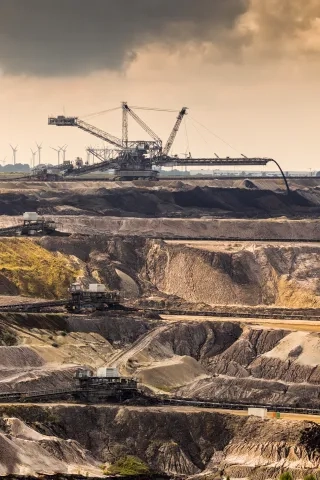
Increased demand for mineral raw materials has led to an urgent need and a political momentum to improve mineral resources governance and sustainable infrastructure. The outcome of these activities will be reported to the fifth session of the United Nations Environment Assembly (UNEA-5), to be held in Nairobi, Kenya, in February 2021.
In March 2019, the United Nations Environment Assembly adopted Resolution EA.4/L.23 on Mineral Resource Governance (MRG), which promotes the collection of information on sustainable mineral resource practices and identification of knowledge gaps and options for the implementation strategies of metal and mineral resources. It also calls for the creation of an overview of existing assessments for different governance initiatives and approaches.
“The adoption of the resolution was an important step because mineral resource management lies at the heart of sustainable development,” said Franz Perrez, Ambassador for the Environment at Switzerland’s Federal Office of the Environment. “The extraction but also the use of mineral resources can pose a fundamental threat to the environment,” he added.
To support the process, the Mineral Resource Governance initiative was created to implement the resolution through convening a series of virtual regional consultative meetings, which will gather inputs from diverse stakeholders across all regions.
Infrastructure development also plays a critical role in mineral resource usage, with infrastructure using a large proportion of extracted metals and minerals. To address this key issue, the fourth UN Environment Assembly passed Resolution EA.4/L.6 on Sustainable Infrastructure, which complements the MRG resolution. It encourages the development of policies on responsible infrastructure and requests the creation of a compilation report of best practices drawing on existing initiatives and the identification of knowledge gaps. It also promotes the development of public-private partnerships and investment to advance sustainable infrastructure.
The Sustainable Infrastructure Partnership (SIP) started by the United Nations Environment Programme (UNEP) in 2018, follows the aims of the resolution and provides a platform to promote integrated approaches to sustainable infrastructure planning and development. In collaboration with a broad range of stakeholders, the SIP provides knowledge, facilitates international collaboration and supports capacity building at the country level to foster systems-level approaches, which more fully exploit the complex interlinkages between infrastructure and the Sustainable Development Goals (SDGs).
UNEP Executive Director Inger Anderson emphasised the imperatives of forming such a partnership given the infrastructure’s central role in the SDGs. “Infrastructure is absolutely critical; done less optimally and wrong, it can negatively arrest our hope to achieve the SDGs,” she said.
As part of the implementation of the SIP resolution, UNEP has led the development of an internationally applicable Good Practice Guidance Framework on integrated approaches to sustainable infrastructure, complemented by a collection of sustainable infrastructure case studies. A round of regional consultations are held to gather feedback on the framework.