
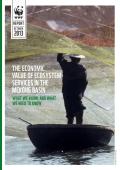
In green economies, natural capital is incorporated into measurement of societal progress and equity, and recognized and managed as a fundamental pillar of economic and human well-being. The Lower Mekong region must demonstrate success in living up to commitments to maintain ecosystem integrity before claims to having ‘greened’ growth can be made. A first step in making this commitment is ensuring that there is adequate information available on the socioeconomic importance of ecosystems and the services they provide. Ecosystem services valuation is a basic component of the evidence base for decisions to invest or divest in maintaining natural systems.
This report advocates placing REDD+ into a larger landscape scale planning framework that can, and should, involve multiple sectors (especially those that are driving deforestation, sometimes inadvertently). This would go beyond forests to also serve the needs of energy, water resources, agriculture, finance, transport, industry, trade, cities, and ultimately all sectors of a modern economy. REDD+ would thereby add value to many other initiatives that are being implemented within these sectors. No longer simply an intriguing pilot effort, REDD+ would take its place as a critical element in a Green Economy.
River Basin Management (RBM) as an approach to sustainable water use has become the dominant model of water governance. Its introduction, however, entails a fundamental realignment and rescaling of water-sector institutions along hydrological boundaries. Creating such a new governance scale is inherently political, and is being described as politics of scale. This paper analyzes how the politics of scale play out in the institutionalization of RBM in Mongolia. It furthermore scrutinizes the role of the broader political decentralization process in the introduction of RBM, an issue that has so far received little attention. Finally, it assesses whether the river basin is an adequate water management scale in Mongolia.
Anthropogenic climate change is a formidable global challenge. Yet countries’ contributions to global greenhouse gas emissions and the climate change impacts they face are poles apart. These differences, as well as countries’ different capacities and development levels, have been internationally acknowledged by including the notion of Common But Differentiated Responsibilities (CBDR) and Respective Capabilities under the 1992 United Nations Framework Convention on Climate Change (UNFCCC).
The private sector is increasingly being engaged in climate finance and climate-related activities. Private sector opportunities for engagement in climate change adaptation are less clear than for mitigation, particularly in developing countries. This article first conceptualizes private sector engagement in adaptation by exploring (1) different roles of the private sector in adaptation in developing countries and (2) the way governments can create an enabling environment to increase private sector engagement. Second, it analyses how 47 least developed countries (LDCs) envisage the role of the private sector in their National Adaptation Programmes of Action (NAPAs). This article argues that private sector engagement in adaptation is often inevitable and potentially significant. Yet, the results show that it receives little attention in NAPAs.