
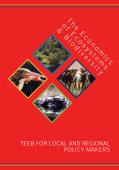
This document is intended to offer inspiration and practicable suggestions for the improvement and maintenance of the welfare of the environment and its inhabitants. TEEB in Local and Regional Policy and Management shows how by taking nature’s benefits into account, decision makers can promote local development to ensure human well-being and economic growth and stability, while also maintaining environmental sustainability.
This volume of the TEEB series of studies explores the potential for local development provided by an approach based on nature. It offers examples of successful implementation of this approach from across the world, highlighting the importance of local decision making in management and planning. The study provide tools and practical guidance for reform, and examines what local governments can do with respect to natural resource use and management, maintaining and supporting biodiversity, local and regional urban and spatial design, as well as market-based approaches, such as Payment for Ecosystem Services (PES).

This report focuses on the risks of climate change to development in Sub-Saharan Africa, South East Asia and South Asia. Building on the 2012 report, Turn Down the Heat: Why a 4°C Warmer World Must be Avoided, this new scientific analysis examines the likely impacts of present day, 2°C and 4°C warming on agricultural production, water resources, and coastal vulnerability for affected populations. It finds many significant climate and development impacts are already being felt in some regions, and in some cases multiple threats of increasing extreme heat waves, sea level rise, more severe storms, droughts and floods are expected to have further severe negative implications for the poorest. Climate related extreme events could push households below the poverty trap threshold. High temperature extremes appear likely to affect yields of rice, wheat, maize and other important crops, adversely affecting food security. Promoting economic growth and the eradication of poverty and inequality will thus be an increasingly challenging task under future climate change.
This brief describes several ways that international cooperation can play a critical role in facilitating widespread innovation and implementation of new and appropriate green growth technologies. It outlines six existing institutional structures that have been invoked as possible examples for scaling up to foster green innovation more broadly and suggests several policy recommendations that are feasible in the near term.
This paper addresses the issues of urbanisation and green growth in Africa from the perspective of what it would take for African cities and countries to accommodate the upcoming urban explosion without the usual negative impact on the physical environment, and using it as an opportunity for innovative and green growth. The paper is organised in four parts. Part I reviews the performance of the African region, economic growth, urban expansion and the characteristics of the urbanisation process. Part II suggests a framework to discuss green growth at city level. It focuses on sectors normally under city responsibility (land, buildings, waste, urban transport) and reviews the use of public policies, including regulation, pricing, tax and investment criteria. Part III discusses combinations of policies for African cities at different stages of urbanisation and urban growth. Part IV summarises the key points for a forward-looking policy agenda. The reports draws on literature produced on Green Economy by UNEP, the World Bank, OECD, African Development Bank and provides relevant examples from Africa and cities in the world.