

The Donor Committee for Enterprise Development (DCED) shares experience amongst its 23 bilateral and multilateral member agencies to generate evidence-based understanding of best practice in Private Sector Development. In 2011, the DCED formed a Green Growth Working Group as a response to the emerging interest amongst its members in linking concerns over environmental sustainability with traditional Private Sector Development strategies (PSD). Since then, many new and innovative approaches to green growth have been designed and tested in the field. However, there is very little practical evidence on what can be done to enhance the efficacy of green growth interventions. In this context, the DCED decided to take stock of different members’ green private sector development initiatives over the past 3 years. Here I highlight a few of the key insights which emerged from our analysis of 120 interventions from 14 member agencies.
How can agencies influence the private sector to adopt greener practices?
For the first time, this report provides a clear mapping of the different drivers influencing companies’ decisions to make green investments or change practices towards environmentally friendly behaviours. Cost savings, Corporate Social Responsibility and market/buyer requirements can encourage companies to take up green business operations and investments. The financial sector is often critical to enabling these investments. Governments can promote green growth through regulation or awareness-raising. Agency interventions typically try to influence one or several of these green growth drivers.
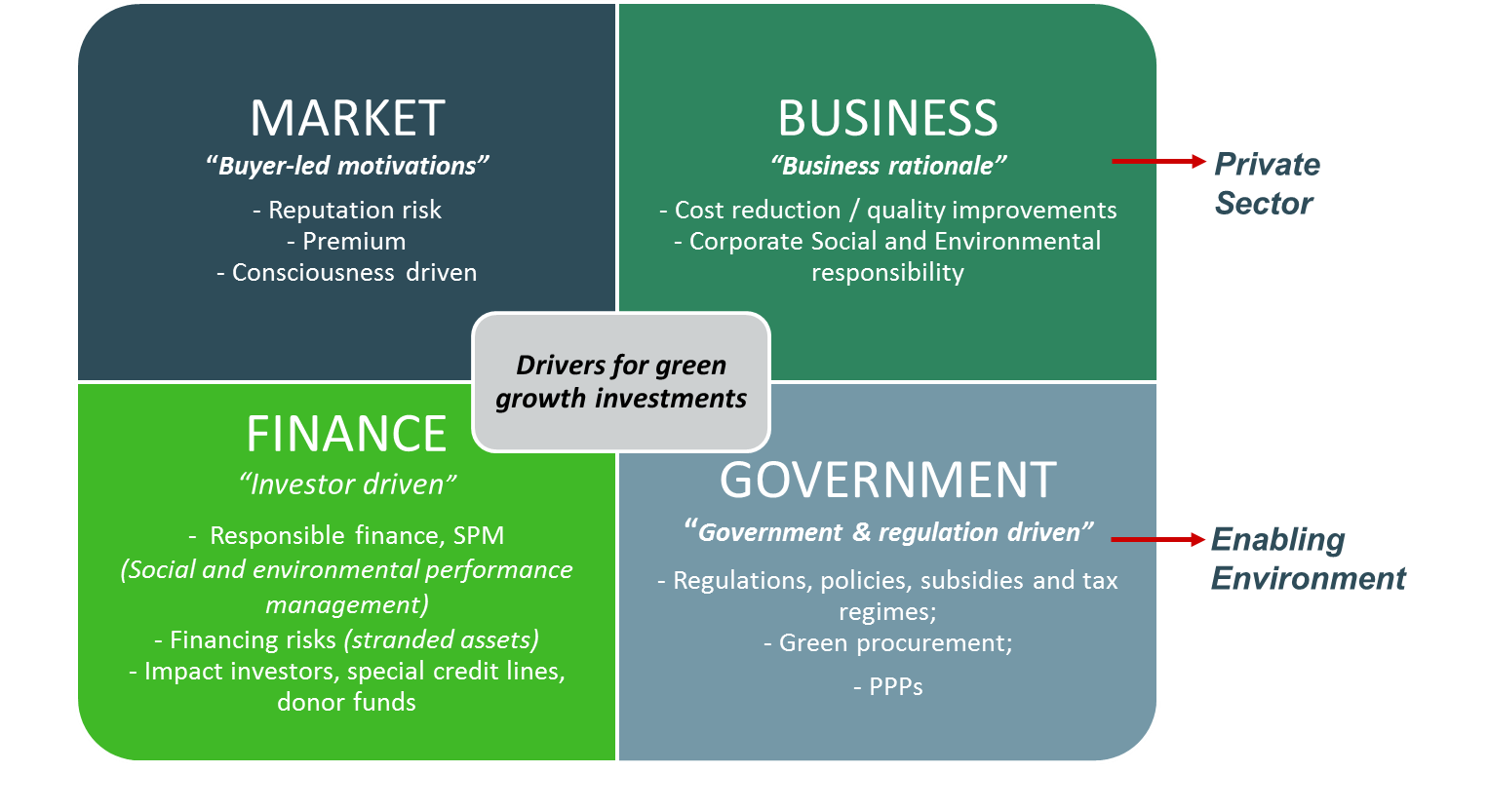
Emerging lessons in green private sector development initiatives
The stocktaking revealed a great deal of diversity in the approaches taken to influencing these drivers. It was possible, however, to identify key clusters of different intervention approaches, namely:
- Green market and value chain development
- Targeted approaches focussing on improving the resource-efficiency and environmental practices in MSMEs (Micro, Small and Medium Enterprises) or multinational corporations
- Access to finance initiatives
- Reform to public policy
Specific lessons related to each of these are elaborated on in the report. Here, however, I will focus on a number of broader insights related to the potential trade-offs and win-wins in the pursuit of greener growth:
There is significant potential for complementarities between different approaches. In particular, we can aim to improve the environmental performance of businesses within existing framework conditions, whilst aiming to change these conditions to reach new, greener development paths over time. Regarding the ‘business’ driver, for instance, targeted approaches focussing on improving the resource-efficiency of operations in MSMEs or multinational corporations coexist with green market and value chain development which aim to develop long-term offer new, greener, business opportunities. The former comprises interventions such as the European Commission’s MEET-BIS Vietnam project, which aims to demonstrate to MSMEs in a multitude of sectors the cost savings associated with investing in energy-efficient and water-efficient technologies. An example of the latter is the African Biogas Partnership Programme, which intends to create self-sustaining commercial markets for domestic biogas plants that not only provide organic bio-slurry that improves yields and reduces green house gases, but also provide significant employment opportunities (in particular for women) in the construction and repair of the plants.
However, it is important for agencies to be explicit about the future implications of interventions which take a shorter term perspective. Short term interventions which improve the resource efficiency of an industry which depletes natural resources, such as forestry, may be effective at reducing poverty and carbon footprints in the short run. However, they may also involve trade-offs for future green growth if they are not complemented by efforts to create alternative, ideally preferable, employment opportunities in greener sectors.
Clarification of the trade-offs between green growth and pro-poor growth in the present also demand attention, and efforts to convert them into win-wins. For example regulations, standards or buyer requirements related to green or sustainable practices can create barriers for SMEs – and especially for small businesses and smallholder farmers which lack the knowledge and capital to meet them. There are project examples which show that partnerships between international cooperation agencies and governments and buyers can play a critical role in building the capacity of SMEs to achieve compliance. For example, the Sustainable Trade Initiative (IDH) –a platform for public and private partners to work and invest together in social and environmental aspects of supply chains – now has a component entitled the Certification Capacity Enhancement project.
Looking to the future
The DCED’s stocktaking reveals numerous emerging lessons for specific approaches in the field of green growth, but also significant knowledge gaps – indeed, addressing these gaps will shape the work of the DCED Working Group in coming years. Yet a clear takeaway of the report is that much can be done in the present by international cooperation agencies to improve the efficacy of their green growth interventions by more actively considering the trade-offs they may involve. It will not always be possible to convert these trade-offs into win-wins for green and pro-poor growth, but greater collaboration with other agencies, the civil sector and private sector to identify the potential interactions of different interventions, and/or prevent unintended consequences of individual interventions, may go some way to maximising both social and environmental outcomes.
Any comments or queries relating to this blog post are welcome and should be sent to 'coordinator (at) enterprise-