
This report provides an update on the deployment of blended finance in LDCs. It also analyses its potential role in helping those countries recover from the COVID-19 crisis, and provides an Action Agenda for unlocking capital for the achievement of the SDGs in LDCs, as called for in the 2030 Agenda for Sustainable Development and the Addis Ababa Action Agenda.
This manual provides policymakers with a methodology for conducting a review of a country’s Inclusive Green Economy Policy framework, to take the pulse of the concept and related policies 10 years after the work on UNEP’s Green Economy report was launched.
This report reviews South Africa’s industrial policy, from an inclusive green economy lens. It investigates the extent to which South Africa’s industrial policy is responding to, if not driving, the country’s transition. Building on this analysis, recommendations to foster green industrial development in South Africa can be formulated. They are split into four complementary components: capacity building; policy mainstreaming; information/data systems; and transition planning.
In order to help countries to review and assess the coherence and effectiveness of existing policies in fostering Inclusive Green Economy transitions to achieve the SDGs, UNEP developed a green economy policy review methodology. This summary showcases the results of a longer study that used the methodology to review Ecological Compensation Policies of Hainan Province in China.
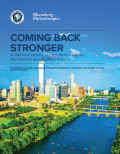
This report offers ideas across six sectors, highlighting city success stories for each : Access and mobility, Buildings, Power, Broadband, Water, and Natural Systems.
Decision-making in the extractive sector is shaped by a complex array of governance frameworks and initiatives operating along highly globalized mineral value chains. The report maps more than 80 existing international governance frameworks and initiatives which focus on delivering overlapping subsets of the 2030 Global Agenda for Sustainable Development, but do not currently operate in a sufficiently coordinated or integrated manner. In this context, the report calls for a new governance framework for the extractive sector referred to as the “Sustainable Development Licence to Operate” and including consensus-based principles, policy options and best practices that are compatible with the Sustainable Development Goals and other international policy commitments.
This report provides information for policy and business decision-makers on the fundamentals of Extended Producer Responsibility (EPR) schemes, including legal frameworks and detailed country-level assessments.
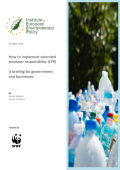
This report is designed as guidance for businesses and governments to aid the introduction of Extended Producer Responsibility (EPR) schemes and legislation. It provides a background on EPR schemes as a tool for the construction of functioning waste management systems and explains the feasible next steps towards these schemes.
This 2020 State of Transition Report from the Transition Pathway Initiative (TPI) is the latest in a series of annual stocktakes of the progress being made by the world’s biggest and most emissions-intensive public companies on the transition to a low-carbon economy.
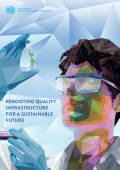
This report provides a holistic overview of the need for quality infrastructure to attain the SDGs. It highlights the need for quality infrastructure to adapt to a new future, focusing on a circular economy that is inclusive, economical, ecological, and sustainable.