
This report provides a detailed assessment of the structures and processes encompassing key Malawi government institutions and civil society organisations in the area of development, environment and natural resource management. It identifies their roles, mandates and policies. Based on this assessment, the report provides pointers to the areas for potential Poverty‐Environment Initiative (PEI) support.
Cette note de synthèse reprend les conclusions principales du rapport du même nom. Elle présente les principaux résultats, soulignant nettement que la préservation et la bonne gestion des ressources naturelles est un facteur important de la croissance économique et de la lutte contre la pauvreté.

This primer provides guidance on presenting evidence about the economic, development, and poverty reduction benefits of the environment to public sector decision-makers, so as to justify and promote “environmental investment”.
This policy brief provides the first-ever public expenditure review for the environment and natural resources in Rwanda. It was written under the theme: “Putting environment on budget.”
The scope of this study includes a review of public expenditure in the environment and natural resources sector, encompassing expenditure incurred by ministries, government departments and other agencies, and the local administration at the Dzongkhag and Geog levels on environment-related interventions along with all donor-supported projects of the environment sector.
This report provides the first-ever public expenditure review (PER) for environment and natural resources in Rwanda. It was written under the theme: “Putting environment on budget.” The objective was to evaluate the appropriateness in the use of funds in the environment sector.

This training manual on how to carry out a "Public Expenditure Review" was commissioned by the Rwanda Environment Management Authority (REMA) in support of the implementation of the Poverty-Environment Initiative (PEI). Broadly, the initiative aims to enhance the contribution of sound environmental management to poverty reduction, sustainable economic growth, and the achievement of the Millennium Development Goals.
This report describes the programme framework of the Poverty-Environment Initiative (PEI) in Nepal, which has the overall goal to support poverty reduction and inclusive development by integrating climate and environmental concerns and opportunities of the poor into development planning and economic-decision making.

This Inception Report and Work Plan responds to Contract No. 13288 from UNEP to “support the strengthening of the capacity of the Government of Rwanda, particularly in the Ministry of Finance in the area of environmental mainstreaming, environmental fiscal reform, and public expenditure reviews”.
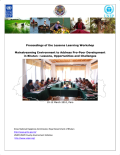
This report encapsulates the key takeaways from the Workshop held in Bhutan with two main objectives, namely, 1) to take stock of environmental mainstreaming achievements to date, including Poverty-Environment Initiative (PEI) Phase I, and, 2) to discuss the challenges and opportunities of addressing environmental mainstreaming in the future.