
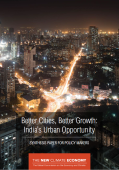
Better Cities, Better Growth: India's urban opportunity provides new analysis across 479 Indian cities – using an innovative combination of satellite data of night-time lights, census, environmental, and economic data – which demonstrates a clear link between more compact, connected urban growth and stronger economic performance in India, corroborating global findings.
India can foster a better urbanisation – one that promotes more rapid economic transformation, improves the quality of life of city dwellers, and curbs the potential harmful spillovers of urbanisation, such as congestion, wasteful energy use, and unwanted pollution. Better, smarter urban growth could be an economic opportunity for India worth up to 6% of GDP by mid-century, with significant savings at the household level.
Considered to be the largest contributor to the growth in the world’s urban population in the coming years, India and its urbanisation process have reached a critical juncture. As one of the fastest growing countries, urbanisation is undoubtedly an opportunity and a challenge for India with huge implications for the rest of the world.
An Analysis of Physical and Monetary Losses of Environmental Health and Natural Resources in India provides estimates of social and financial costs of environmental damage in India from three pollution damage categories: (i) urban air pollution; (ii) inadequate water supply, poor sanitation, and hygiene; and (iii) indoor air pollution. It also provides estimates based on three natural resource damage categories: (i) agricultural damage from soil salinity, water logging, and soil erosion; (ii) rangeland degradation; and (iii) deforestation.