
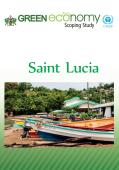
The report Green Economy Scoping Study for Saint Lucia couples an in-depth analysis of Saint Lucia’s agriculture and tourism sectors with a more general review of manufacturing, transport and construction, integrating the key elements of energy, water and waste management.
The study recommends policy reforms that can help speed up the transition to a green economy in Saint Lucia which, like many Small Island Developing States, is disproportionately vulnerable to the impacts of climate change.It also dentifies the most significant challenges for the tourism sector: the high input costs (primarily for energy, water and waste management), competing uses for environmentally sensitive areas accompanied by inadequate land use policies (particularly in coastal areas) as well as the need to diversify Saint Lucian tourism beyond “sun, sea and sand” vacations.
Since 2005, the United States has invested approximately US$ 87.2 million to fund the Central America-Dominican Republic-United States Free Trade Agreement (CAFTA-DR) environmental cooperation. This funding is helping CAFTA-DR countries advance in the following four programmatic areas: (A) Institutional Strengthening for Effective Implementation and Enforcement of Environmental Laws; (B) Biodiversity and Conservation; (C) Market-based Conservation; and (D) Improved Private Sector Performance.
In support of these areas, the Environmental Cooperation Agreement (ECA) (Article IV) requires that the Environmental Cooperation Commission (ECC) be responsible for examining and evaluating the cooperation activities under the Agreement. The ECA highlights as well that the ECC must also seek and consider input from relevant international organizations and other stakeholders regarding how best to ensure that it is accurately monitoring progress.
Although evidence shows that women are both victims of climate change and important contributors of knowledge and skills in disaster risk, adaptation and mitigation strategies, the gender perspective is largely missing from the design and planning of climate change responses and policies. In addition, most research into gender and climate change has been exclusively conducted in rural contexts. There is strong scope for filling these knowledge gaps to improve the understanding of the relationship between gender and climate change in urban settings.
This policy brief explores the advantages and challenges of integrating a gender dimension into climate compatible development strategies in urban settings, with a focus on the Asian Cities Climate Change Resilience Network (ACCCRN) project in India. An initiative funded by The Rockefeller Foundation, the project was implemented in Gorakhpur, Uttar Pradesh by the Gorakhpur Environmental Action Group (GEAG).
Climate change is increasingly recognised as a global crisis, but solutions have so far focused on scientific and economic options, rather than on the human and gender dimensions. Despite the fact that marginalised and poor people, including women, are affected first and hardest by climate change, evidence indicates that women’s views, needs and participation are excluded from the design and planning of climate change responses, including major policies. Moreover, women are often perceived primarily as victims, and not as equal contributors of knowledge and skills in disaster risk, adaptation and mitigation strategies.
This brief is based on a research project carried out by Practical Action Consulting with support from the Institute of Development Studies, commissioned by and supported by the Climate and Development Knowledge Network (CDKN), to provide evidence on the advantages and challenges of integrating a gender dimension into climate compatible development strategies in urban settings, with a focus on Peru, India and Kenya. Although considerable evidence exists pertaining to rural areas, significant knowledge gaps can be found in relation to climate compatible development and gender in urban areas. The research attempts to respond to the following four questions: