
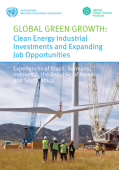
This report examines the specific industrial policy measures promoting a low-carbon transition in five focus countries, specifically Brazil, Germany, Indonesia, the Republic of Korea and South Africa, through a compilation of expert review studies. It shows that across all levels of development, major attention is being paid to the threats of climate change and opportunities of pursuing a low-carbon development path, and dedicated efforts are presented to operate efficient industrial policies to enhance green growth. However, it is clear that the major focus in developing countries will need to be on green investments and on creating an enabling environment for such investments if the global economy is to effectively combat climate change.
This report is the second volume in a two volume set. Volume I of the report, providing overall findings from the project, can be accessed here.
Renewable energy has been considered as the solution to the hydra-headed problems of energy security, energy access and climate change, especially in Africa. In addition, renewable energy sources, such as the sun, wind, wave and waste abound in Africa are in need of investment. In order to provide both policy and investment guidance, this study investigates the drivers of renewable energy demand in oil-producing African countries. Three panel data models – a random effect model, a fixed effects model and a dynamic panel data model – are used to estimate renewable energy demand with a comprehensive set of determinants. The estimation results indicate that the main drivers of renewable energy in oil-producing African countries are real income per capita, energy resource depletion per capita, carbon emissions per capita and energy prices. The study recommends that policies should encourage the consumption of commercial sources of renewable energy to attract the needed investments.
Natural resources are the foundation of economic development. This report reveals the patterns and the evolution of natural resource use with 118 indicators in 26 countries of the Asia and the Pacific region over the last 40 years. The analysis shows that resource use in the region is both inefficient and unsustainable. The Asia-Pacific region will not be able to base its future economic growth on declining costs of natural resources as was possible during most of the twentieth century. An increasing reliance on resources from abroad and volatility in the global resource markets will pose challenges to the economic resilience of countries in the region. In this new economic context resource efficiency and decoupling of economic growth and resource use will be fundamental to the economic success of the region. The knowledge generated by this report helps to improve the understanding of the natural resource use and emissions consequences of economic growth in Asia and the Pacific to support policy formulation, monitoring and policy evaluation in the countries of the region.