
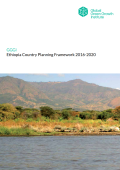
The purpose of this Country Planning Framework (CPF) is to detail how GGGI will support the government of Ethiopia to plan and implement the Climate Resilient Green Economy (CRGE) vision between 2016 and 2020.
Energy Access Explorer, led by the World Resources Institute, is an online, open-source, interactive platform that uses mapping to visualize the state of energy access in unserved and underserved areas. It analyzes credible and public data (remote sensing data as well as data from global, national, sub-national and census databases) to make the connection between the demand and supply of energy. Individuals can create custom analyses on Energy Access Explorer to identify and prioritize areas where energy markets can be expanded.
The Private Financing Advisory Network (PFAN) is a global network of climate and clean energy financing experts, that aims to bridge the gap between entrepreneurs developing climate and clean energy projects and private sector investors.
Developed by the Expert Group on Technology Transfer of the United Nations Framework Convention on...
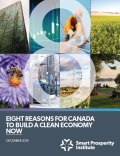
The shift toward a low-pollution, innovative, resource-efficient economy is the opportunity of the century. This report outlines eight reasons why accelerating this transition is the path to prosperity for Canada.
The cheap power purchase agreements (PPAs) for two recent concentrating solar power (CSP) projects in Australia (Aurora) and Dubai (DEWA IV) raise questions of how such low costs can be achieved and whether this could mark the commercial breakthrough of this technology. This paper investigates these projects with the information available and seeks reasons for the low PPAs.

This report aims to: (1) Understand the perceived benefits and risks, including ethical issues, as well as the levels of acceptance and support for joint projects in renewable energy (concentrated solar power and wind energy projects) among the public in various EU countries; (2) Understand the motives for potential rejection of cooperation mechanisms; and (3) Explore the determinants of public acceptance and support for cooperation mechanisms. It examines public perceptions of two potential joint projects set up under the Renewable Energy Directive in Spain, Germany, the Netherlands, and Romania.
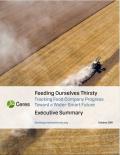
Food companies are not only at risk due to water scarcity, they are also responsible for it. Agriculture is rapidly draining aquifers in many regions of the world, and meat production is one of the biggest polluters of watersheds globally. This report provides investors with guidance and relevant data for evaluating the water risk management of 40 major companies in the agricultural products, beverage, meat, and packaged food industries. It also tracks their progress in managing their water risks as compared to performance in 2017 and 2015. This analysis can help food companies manage their water risks more effectively, which is critically important to their bottom lines.
This guidance document provides a practical framework that can be used to identify, prioritise and include mitigation measures that can increase a country’s climate change mitigation ambition through actions that improve local air quality. It also outlines how this can be reflected in the updated Nationally Determined Contribution (NDC) and accompanying information.
This report calls for national governments to prioritise compact, connected, and clean cities in order to secure economic prosperity and tackle the climate crisis. The report quantifies the necessary investments as well as the potential benefits available to governments willing to invest into zero-carbon cities and it sets out a six-part action plan on advocating for ambitious, coordinated climate action.
This report Climate and energy investment map in Germany: Status report 2016 presents a map illustrating the volume of climate and energy investment flows – from the financing sources, through the intermediaries and financial instruments, to the recipient sectors (i.e. agriculture, buildings, energy, industry, and transport sectors).