
This study, which calculates the economic cost of nature’s decline across 140 countries, shows that the loss of six ecosystem services under a business-as-usual trajectory leads to losses of US$9.87 trillion in real GDP by 2050. This represents an annual loss of US$479 billion per year. In contrast, under a scenario in which land-use is carefully managed to avoid further loss of areas important for biodiversity and ecosystem services, economic outcomes would be dramatically better, with global GDP rising by $490 billion per year above the business-as-usual calculation.
This report presents the objectives, methodology, procedures and main findings of the OECD project "Strengthening public finance capacity for green investments in the EECCA countries". Between 2016-19, the project aimed to help set the partner countries (Kazakhstan, Kyrgyzstan and Moldova) on a sustainable path of development by reducing the energy and carbon intensity of their economies.

This report analyses the current legal framework and operational set-up for Extended Producer Responsibility (EPR) in Kazakhstan and makes recommendations for strengthening and improving the current system further.
This publication shows that Kazakhstan’s environmental payments for industrial air pollutants, as currently applied, impede energy efficiency and pollution abatement with heavy-handed non-compliance responses and focus on rising revenues. They also add to the cost of doing businesses in the country, with limited environmental benefit. In the spirit of the Polluter-Pays Principle, much more regulatory reform on environmental payments are needed. This report provides guidelines for reform.
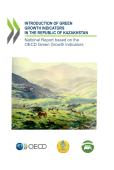
This report presents the results and conclusions of the project “Introduction of Green Growth Indicators and Preparation of the Report on Green Growth in Kazakhstan”, carried out within the framework of the OECD Kazakhstan Cooperation Program. The main goal of the project is to assist Kazakhstan in integrating the measurement of green growth into the regular reporting and planning system, in implementing the concept for the transition to a green economy, and in assessing progress and achieving green growth at the macro level.
This report presents the results from Phase II of the Air Emissions Inventory Project. It is the first national air pollutant emission inventory carried out for the whole country. The emissions inventory shows that emissions from the stationary energy and transport sectors dominate the emission sources. For particulate matter, the dominant source is industrial processes and product use (IPPU). Although the agriculture and waste sectors have a minor contribution to the country’s overall emissions, their role is more significant in terms of greenhouse gas emissions. However, of particular note are the estimated high non-methane volatile organic compounds (NMVOCs) emissions from municipal solid waste disposal on land.
This publication introduces the Gender Mainstreaming Framework in the energy value chain as well as provides different case studies on gender inclusion from India and Nepal. The case studies focus on gender mainstreaming practices in the energy sector—specifically in the off-grid, grid connected, and clean cooking segments. They highlight the practical interventions and capture their replicable processes and aspects.
Visioning Futures: Improving infrastructure planning to harness nature’s benefits in a warming world
This report outlines a new planning approach integrating considerations of natural capital and ecosystem services, climate risks and resilience, and sustainable development needs to support social-ecological system scale planning. It provides key recommendations for global and local institutions influential in infrastructure development, from multilateral development banks and other funders to NGOs and the private sector, to address these gaps and facilitate an improved planning approach.
This report explores the linkages of Nationally Determined Contributions (NDCs) and the Sustainable Development Goals (SDGs) and captures if these linkages are evident in countries’ NDCs. It offers the first essential step in further strengthening institutional linkages at multiple governance levels for achieving SDGs and NDCs simultaneously and efficiently.
The paper is the first in a two-part series on The Net-Zero Challenge, which examines what corporations, governments, and civil society have achieved since the Paris Agreement was drafted in 2015 and assesses the current state of global climate action. While there are clear signs of incremental progress, climate action needs to move at a much greater scale and faster pace.