
This Agriculture Sector Wide Approach (ASWAp) is organized in relation to three focus areas, two key support services, and mainstreaming of cross-cutting issues covering:
- Focus Areas: a) Food security and Risk management, b) Agri-business and market development, and c) Sustainable land and water management.
- Key-support Services: a) Technology generation and dissemination and b) Institutional strengthening and capacity building.
- Cross-cutting Issues: a) HIV and AIDS pandemic and b) Gender disparities
The manual, which contains numerous case studies of best practices, offers a practical guide for undertaking ecosystem assessments and includes tools and approaches that can assess options for better-managing ecosystems.
This publication brings together seven papers prepared as “analytical notes” for the Donor Working Group on Environment. These notes synthesize the current status of Mozambique’s environmental policy as applied in various sectors, with regard to environmental legislation and policy, and assess the challenges ahead in order to contribute to the particular sectors phase with regard to environmental issues.
The report outlines how poverty levels and challenges of meeting the Millenium Development Goals (MDGs) in Rwanda are closely linked to widespread environmental degradation, a challenge further complicated by the fact that the economy is not sufficiently financed to address them.
The aim of this study is to analyze the current coordination and communication mechanisms between institutions in the process of integrating environmental issues into sectoral planning and budgeting, as a basis for supporting MICOA and MPD in exercising their coordination roles.
O objectivo deste estudo é analisar os mecanismos actuais de coordenação e comunicação entre as instituições no processo de integração de assuntos ambientais na planificação e orçamentação sectorial, como base para apoiar o MICOA e o MPD no exercício dos seus papéis de coordenação.
This document presents the country's current socio-economic situation, the challenges on which the strategy to achieve inclusive economic growth for poverty reduction is defined, and a description of the general objectives and supports pillars and their respective priorities. To ensure the implementation of these priorities, a resource allocation projection is presented for the duration of the Plan.
O presente documento apresenta a situação sócio económica actual do país, os desafios na base dos quais se define a estratégia para alcançar o crescimento económico inclusivo para a redução da pobreza, uma descrição dos objectivos gerias e pilares de apoio e as suas respectivas prioridades. Para assegurar a implementação destas prioridades é apresentado uma projecção de alocação de recursos para a vigência do Plano.
This report defines the scope of the environmental sector and provides a detailed methodology based on which data has been collected, analyzed, and reported. Also, it gives a comprehensive analysis of the preliminary findings of both quantitative and qualitative data, including macroeconomic performance, policy and legal frameworks, methodology, and preliminary assessment of the Public Environmental Expenditure Review (PEER).
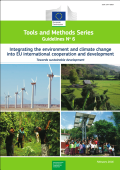
These guidelines provide a framework for strengthening the contribution of European Union (EU) international cooperation and development policy to sustainable development by integrating, or mainstreaming, environmental and climate change considerations into the different phases of the EU programme and project cycle. The guidelines are intended for staff in the European Commission (EC), EU Delegations, and partner institutions.
The guidelines are presented in three chapters, complemented by additional resources;
- a separately published executive summary;
- nine annexes that provide practical tools and examples, including template terms of reference (ToR);
- sector notes (in development) and a series of climate change sector scripts,
The tools included will help policymakers understand the interlinkages within and between environment-related goals and targets; promote policy coherence and integration of the environmental dimensions of the SDGs; and help develop indicators, policies, and institutional arrangements to support progress toward the environment-related dimensions of the SDGs.
The aim of this assessment is to find out the level of implementation of environment and climate change (ECC) activities in the Sectors and districts’ plans/ reports and provide recommendations on issues that require special attention to support concerned Sectors and districts to better plan for further achievements. The report also takes into consideration the budget spent on environment and climate change interventions in relation to the total national budget spent by districts and sectors for the fiscal year 2017/18.