
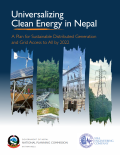
Despite holding a mammoth potential for generating clean hydropower, every three in ten rural Nepalese continue to live in darkness.Universalizing Clean Energy in Nepal: A plan for sustainable distributed generation and grid access to all by 2022, jointly undertaken by the National Planning Commission and the Nepal Electricity Authority’s Engineering Company, presents insights for policymakers and offers a practical guide for relevant stakeholders to undertake the ambitious task of supplying electricity to each municipality with their own generation.
The Uganda Green Growth Development Strategy has been developed to operationalize the broad green growth tenets highlighted in Agenda 2030, the Uganda Vision 2040 and the NDPII (2015/16-2019/20) to support the country’s accelerated transition to middle-income status. This strategy document outlines the challenges and opportunities for green growth in the country; introduces a Green Growth Development Strategic Framework; discusses enabling arrangements in governance and resource mobilization; and introduces a Road Map for Implementation.
The water and environmental resources are critical in Uganda's national transformation and sustainable development. This document, Water and Environment Sector Development Plan, outlines the development priorities being addressed by the water sector; describes the general state of affairs; covers the objectives, strategies, and priority interventions under the Sector Development Plan and National Development Plan (NDPII); and outlines the options for sources of funds to invest in the Water and Environment Sector.
This handbook, Green Growth Assessment & Extended Cost Benefit Analysis: A handbook for policy and investment decision makers, is an introductory guide for policy makers to apply the Green Growth Assessment Process (GGAP) and extended Cost-Benefit Analysis (eCBA) in the planning process. Both tools provide an integrated framework to...
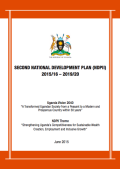
Uganda's Second National Development Plan (NDP II) aims to strengthen the country's middle-income status by 2020, in line with the aspirations of Uganda's vision 2040, by strengthening its competitiveness for sustainable wealth creation, employment, and inclusive growth. It is the second plan in a series of six five-year plans that aim to achieve the Uganda Vision 2040.