
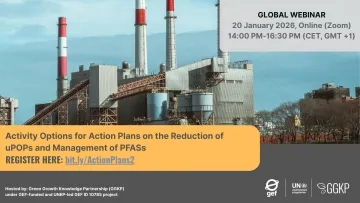
On 20 January 2026 (14:00-16:30 CET), the Green Growth Knowledge Partnership (GGKP), as part of the GEF-funded and UNEP-led Global NIP Update Project (GEF ID 10785), hosted a virtual webinar on Activity Options for Action Plans on the Reduction of uPOPs and Management of PFASs.
The webinar brought together Stockholm Convention focal points, National Implementation Plan (NIP) experts, and POPs management practitioners to explore practical action plan options for reducing unintentional POPs (UPOPs) and managing Per- and Polyfluoroalkyl Substances (PFAS) listed as POPs, in line with Stockholm Convention obligations.
The event introduced the integrated approach for reducing and eliminating uPOPs, including the integrated pollution prevention and control approach of Best Available Technique (BAT) and Best Environmental Practice (BEP) for major Annex C Part II and III sources. It also provided an overview of activity options for managing and phasing out of POP-PFAS towards an overall control of all PFAS, considering synergies with the Global Framework on Chemicals (GFC) and related issues of concern.
The webinar was delivered in English, with simultaneous interpretation into French, Russian, and Spanish.
Objectives
- Introduce aspects of the integrated approach to POPs management, with an emphasis on polychlorinated dibenzo-p-dioxin and dibenzofurans (PCDD/PCDF) and other unintentional POPs.
- Provide an overview of activity options for reducing and eliminating PCDD/PCDF and other unintentional POPs.
- Introduce the integrated pollution prevention and control approach of the European BAT Reference Documents.
- Provide an overview of activity options for managing PFASs listed as POPs and addressing legacies from past PFAS use.
- Introduce broader approaches to substitute the group of PFASs avoiding regrettable alternatives.
Target audience
- Stockholm Convention Official Contact Points and National Focal Points particularly from project countries
- National officials and experts involved in the process of reviewing and updating the NIPs
- Practitioners working on POPs inventory and POPs management
- Members of NIP National Coordinating Mechanism/Committees and Project Coordination Units/Thematic Task Groups
- Representatives of Regional Centers and other relevant stakeholders
Agenda
(Please note that time is indicated in CET)
| TIME (CET) | Description | Speaker |
| 14:00 | Welcome and opening remarks | Moderator: Ms. Janalezza Thuaud (GGKP, UNEP) Opening remarks: Ms. Carla Valle-Klann (BRS Secretariat) |
| 14:05 | Some Basic Considerations on Action Plan Development and Integrated Approach | Dr. Roland Weber (POPs Environmental Consulting) |
| 14:30 | Action Plan Options for Reduction and Elimination of Unintentional POPs (Article 5) and Considerations for an Integrated Approach | |
| 15:15 | From BAT/BEP for Unintentional POP Reduction to Integrated Pollution Prevention and Control of Pollutants to Tackle the Triple Planetary Crises | Prof. Harald Schönberger (Stuttgart University) |
| 15:45 | Options for Action Plan Activities to Control, Manage and Phase out of PFOS, PFOA, PFHxS and Related Compounds and Synergies with the Global Framework on Chemicals (GFC) | Dr. Roland Weber |
| 16:15 | Q&A session | All |
16:30 | Closing remarks |
Speakers
- Dr. Roland Weber, POPs and NIP expert, POPs Environmental Consulting
- Prof. Harald Schönberger, Professor at the Institute for Sanitary Engineering, Water Quality and Solid Waste Management, University Stuttgart, Germany
Contacts
Fabienne Pierre
GGKP Coordinator, Global NIP Update Project Manager (GEF 10785), UNEP
email: fabienne.pierre [at] un.org (fabienne[dot]pierre[at]un[dot]org)
Soomin Bae
Global NIP Update Project Support Consultant (GEF 10785), GGKP, UNEP
email: soomin.bae [at] ggkp.org (soomin[dot]bae[at]ggkp[dot]org)