
These guidelines provide a framework for strengthening the contribution of European Union (EU) international cooperation and development policy to sustainable development by integrating, or mainstreaming, environmental and climate change considerations into the different phases of the EU programme and project cycle. The guidelines are intended for staff in the European Commission (EC), EU Delegations, and partner institutions.
The guidelines are presented in three chapters, complemented by additional resources;
- a separately published executive summary;
- nine annexes that provide practical tools and examples, including template terms of reference (ToR);
- sector notes (in development) and a series of climate change sector scripts,
The tools included will help policymakers understand the interlinkages within and between environment-related goals and targets; promote policy coherence and integration of the environmental dimensions of the SDGs; and help develop indicators, policies, and institutional arrangements to support progress toward the environment-related dimensions of the SDGs.
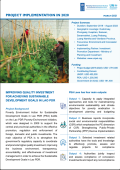
This implementation factsheet provides an overview of the Improving Quality Investment for Achieving Sustainable Development Goals in Lao PDR project background, summary, outputs, and corresponding activities in 2021.
This Corporate Social Responsibility (CSR) Guideline highlights the concept of CSR and the importance of CSR within the tourism business operation context. The main part of the CSR Guideline presents the steps for developing a CSR program from stakeholder mapping to reporting process by providing action planning and reporting template for implementing CSR. In addition, the Guideline provides information regarding different areas where the private sector can contribute to resolving social and environmental issues through CSR initiatives such as poverty eradication, environment protection, human right, and local startup development.
This Monitoring Manual, completed in January 2022 consists of all detailed steps from pre-monitoring to the post-monitoring mission, and budget allocation to support the regular monitoring missions. The Manual includes the monitoring forms to conduct onsite monitoring which link to the Investment Database. The monitoring forms cover all social and environmental obligations to ensure that investment contributes to local development including human resource development, job creation, labor safety, community engagement, and environmental impact mitigation.
The handbook sets out detailed, accessible, practical steps involved in sustainable bond issuance and discusses the associated tasks and activities so as to provide South African municipalities with a comprehensive view of the process entailed in the preparation, issuance, and management of a sustainable bond. It seeks to explore key elements of the instrument and to provide balanced information so South African municipalities – and others – can determine whether a sustainable bond is a suitable tool for their organization. The handbook also contains introductory material concerning sustainable bonds, so readers can familiarize themselves with the terminology, context, purpose, and considerations related to these instruments.
The Guidance aims to deepen the understanding of the EIA processes as a whole and improve their writing skills and application of technical and methodological approaches in line with Myanmar’s procedural requirements as well as internationally recognized performance standards. Its design is based on the capacity needs assessment of the private sector and civil society actors that identifies gaps in EIA investigations and reporting in Myanmar and the capacity development needs of project developers to adopt robust social and environmental safeguards.
This toolkit aims to serve as a one-stop-shop for local and regional governments to enable the identification, design and implementation of renewable energy projects within a public-private partnership framework.

This guide is designed to inform policymakers of the process needed to implement effective waste licensing legislation supported by appropriate environmental monitoring requirements.

This brief provides arguments for the mainstreaming of the environment in the Economic Development and Poverty Reduction Strategy in progress in Rwanda.