
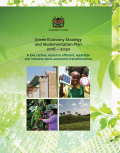
Green Economy Strategy and Implementation Plan 2016-2030 is geared towards enabling Kenya to attain a higher economic growth rate consistent with the Vision 2030, which firmly embeds the principles of sustainable development in the overall national growth strategy. This strategy builds on the achievements realised during the implementation of...
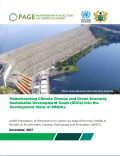
The Partnership for Action on Green Economy (PAGE) is a flagship UN inter-Agency (UNIDO, UNITAR, ILO, UNEP and UNDP) programme to support participating countries to transition to an inclusive green economy. In Ghana's context, PAGE is supporting the country's efforts to fully integrate Sustainable Development Goals (SDGs) and internalize Ghana's...
This National Energy Policy outlines the Government of Ghana’s policy direction regarding the current challenges facing the energy sector. The document provides a concise outline of the Government’s policy direction in order to contribute to a better understanding of Ghana’s Energy Policy framework.
The document is divided into nine sections...
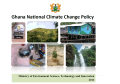
The National Climate Change Policy (NCCP) is Ghana’s integrated response to climate change. It has been prepared and designed within the context of national sustainable development priorities; it provides a clearly defined pathway for dealing with the challenges of climate change within the current socio-economic context of Ghana, and looks...
Between 1991 and 2013, Ghana experienced an impressive decline in absolute poverty from 51.7 per cent to 24.2 per cent. However, the cost of environmental degradation to the country has been high. In 2012 it was estimated that the cost to Ghana of environmental degradation was equivalent to ten per...
This document is presented as Volume II of the Ghana Shared Growth and Development Agenda (GSGDA) II. It represents the costing framework for the effective implementation of the policies and strategies outlined in the GSGDA II. It briefly reviews the costing framework for the financing of programmes and projects under...
Ghana Shared Growth and Development Agenda (GSGDA) II, 2014-2017 - Vol I: Policy Framework provides a consistent set of policy objectives and strategies to guide the preparation and implementation of medium-term and annual development plans and budgets at sector and district levels. It also serves as a platform for donor...
This document is presented as Volume II of the Ghana Shared Growth and Development Agenda (GSGDA). It represents the costing framework for the effective implementation of the policies and strategies outlined in the GSGDA. It briefly reviews the costing framework for the financing of programmes and projects under the GPRS...
Ghana Shared Growth and Development Agenda (GSGDA), 2010-2013 - Vol I: Policy Framework is anchored on the continued pursuit of macroeconomic stability and the sustainable exploitation of Ghana’s natural resource endowments in agriculture, minerals and oil and gas supported by strategic investments in human capital, infrastructure, human settlements, science, technology...
Ghana has one of the largest and fastest growing economies in sub-Saharan Africa, which can be attributed to political stability, good governance and increasing export revenues from cocoa, gold and, more recently, oil production. However, the continuous exploitation of the country’s rich natural resources and the resulting environmental liabilities have...