
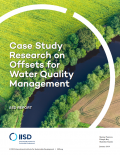
This case study research examines six water quality trading (WQT)/offset programs from Canada, the United States and New Zealand and highlights specific policy and program mechanisms that enabled the programs to achieve their goals of reduced nutrient and contaminant loading.
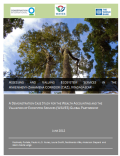
Conducted as a demonstration study for Wealth Accounting and the Valuation of Ecosystem Services (WAVES) in Madagascar, this analysis provides an in-depth assessment of the contribution of key ecosystem services from the Ankeniheny-Zahamena Forestry Corridor (CAZ), the largest remaining contiguous patch of humid forest in eastern Madagascar.
This study measures the mineral reserves in the Philippines, notably nickel, gold, copper, and chromium, based on the System of Environmental-Economic Accounting (SEEA) framework.

This paper provides an overview of land use planning challenges and opportunities in the Greater Mekong Subregion and introduces tools to improve land use planning and management in the subregion.

The Role of Sustainability-oriented Social Enterprises in Boosting Green Livelihoods and Business Opportunities in Rural Contexts reviews the cases of capacity building and knowledge improvement of rural livelihood in rural communities related to sustainable and low-carbon solutions. The reviewed sub-cases show that implementation of local integrated systems of solutions addressing energy, water, shelter and other livelihood needs at community level require paying major attention to enabling social processes and organisational capacities rather than only focusing on a given technological innovation.
This case study takes a look at how Bhutan is taking steps towards putting the Paris Agreement into practice and embarking on a low-carbon, climate-resilient pathway that is adapted to its unique circumstances, and compares Bhutan's efforts with those of other nearby countries.
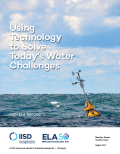
The flow of data on freshwater health is becoming difficult to manage. This report summarizes eight case studies highlighting instances where financial technology (fintech) is being used to improve the understanding of ecological interactions with humans to better inform decision-making and plan for sustainable development and resilience.

This case study Mobike China: Synchronizing social and technological innovations towards sustainable urban transportation shows how technology can be a solution to social, environmental and economic issues.

This case study Fly Ash Bricks: Brick production using fly-ash from thermal power plants in India shows how a green business initiative can be a win-win for power plant operators, the environment and local communities.
This case study Africa Illovo Sugar: Developing climate resilience through collaboration shows how businesses can work together to reduce social, environmental and economic impacts of their production.