Browse Knowledge

Sort by
Organisation for Economic Co-operation and Development (OECD)

The OECD is compiling data, analysis and recommendations on a range of topics to address the emerging health, economic and societal crisis, facilitate co-ordination, and contribute to the necessary global action when confronting the enormous collective challenge of COVID19. A new series of policy response documents span topics from health to education and taxes, providing guidance on the short-term measures needed in affected sectors and a specific focus on the vulnerable sectors of society and the economy. Beyond immediate responses, the content aims to provide analysis on the longer-term consequences and impacts, paving the way to recovery with co-ordinated policy responses across countries.
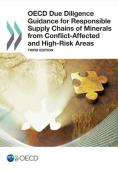
OECD Due Diligence Guidance for Responsible Supply Chains of Minerals from Conflict-Affected and High-Risk Areas_OECD.JPG
Organisation :
Organisation for Economic Co-operation and Development (OECD)

The OECD Due Diligence Guidance provides detailed recommendations to help companies build ethical, transparent and sustainable mineral supply chains in conflict-affected areas.

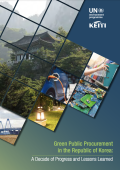
Green-Public-Procurement-in-the-Republic-of-Korea.png
Korea Environmental Industry and Technology Institute (KEITI)
The overall objective of this study is to present the Republic of Korea’s green public procurement (GPP) impact measurement methodology, to compare it to others used by other public authorities internationally, and to pilot a macro-economic analysis of the economic and environmental impacts of the Republic of Korea’s GPP policy in order to improve the approaches used by the government to estimate GPP impacts and benefits. Also, it provides guidance to governments reforming their GPP policies and measurement approaches.
Organisation :
International Labour Organization (ILO)

All around the world climate change, policies to respond to it, and the related economic restructuring have deep implications for jobs. The ILO initiated the Green Jobs Assessment Institutions Network (GAIN) in 2012 to support development of training tools that enhance the capacity of national institutions to build country-specific green employment projection models. This training guidebook has been produced to serve that purpose.

Organisation :
United Nations Environment Programme (UNEP)
This is a roadmap to sustainable accommodation and MICE sectors in the Philippines, via resource-efficient and low-carbon development. Its vision is to enhance a globally recognized tourism destination that showcases and protects the natural beauty of the Philippines, the hospitality of its people and its cultural identity.
Food Waste Index - Methodology_UNEP.JPG
United Nations Environment Programme (UNEP)
The indicator aims to measure the total amount of food that is wasted in tonnes. It complements SDG 12.3.1(a) on Food Loss (which is under the custodianship of FAO) Both indicators look to divide the food value chain and measure the efficiency of the food system.
Anticipating skill needs for green jobs A practical guide_ILO.JPG
Organisation :
International Labour Organization (ILO)

One of the keys to making sustainable development policies successful in terms of environmental, social, and economic outcomes is to ensure the right skills are available when and where they are needed. Countries face different challenges and choose to respond in different ways. This guide focuses on understanding and measuring the skills implications of those challenges and response choices. It provides guidance on how to embark on the identification of current and anticipation of future skills needs for the green economy and green jobs.

Organisation :
One Planet Network
United Nations Environment Programme (UNEP)

A “sustainable lifestyle” is a cluster of habits and patterns of behaviour embedded in society and facilitated by institutions, norms and infrastructures that frame individual choice, in order to minimize the use of natural resources and generation of wastes, while supporting fairness and prosperity for all. This guidance will help policymakers, individuals and other stakeholders understand what a holistic approach to lifestyle means and how different contexts require different lifestyle solutions. It does not set out to define what "the" sustainable lifestyle looks like. Instead, it can help guide a range of initiatives that enable lifestyle choices that contribute to sustainability

The SIYB Implementation Guide is intended as a practical tool to support the introduction and roll out of SIYB activities at country level. It provides step-by-step guidance for the successful implementation of SIYB in a given context.
Photo of cityscape by Miguel Bruna on Unsplash
The Solutions Gateway is an online resource platform designed to support local and regional governments around the work find promising Low Emission Development (LED) Solutions for their communities.