
The TAP finance toolkit aims to empower local and regional governments to have a better understanding on possible climate financing mechanisms, terms and funding opportunities.
The COP21 RIPPLES Scenario Explorer presents national and global transition pathways to support the assessment of major components of the global transformation in energy systems and the wider economy that are required to meet the Paris Agreement.
The “Factsheets on Sustainable Public Procurement in national governments” is a supplement to the 2017 Global Review of Sustainable Public Procurement. It features 40 country factsheets that illustrate the current state of sustainable public procurement (SPP) policies, activities, programmes, and monitoring and evaluation systems in national governments around the world.
This report jointly commissioned by the Green Climate Fund (GCF) and the Climate Investment Funds (CIF) shows that country-driven coordination and collaboration between funds in blending finance can lead to better development outcomes, enhanced efficiency, and increased financing in developing countries.
TO
Online

On April 5 to June 5, ILO's International training Center is offering the Green Jobs for Sustainable Development: Concepts and practices course that provides an interactive e-learning opportunity to explore green jobs concepts and emerging practices.
This report aims to help countries enhance climate action by including the opportunities offered by nature-based solutions in their revised NDCs. It reviews guidance from several institutions on using nature-based solutions for climate change and how nature-based solutions are featured in existing NDCs.
Building the Future of Quality Infrastructure provides a timely guide to promoting innovative financing of infrastructure such as transportation networks, water and sanitation facilities, and digital networks vital to realising more resilient and inclusive economies.
In The Impacts of Rural Credit on Agricultural Outcomes and Land Use, Climate Policy Initiative provides a detailed impact analysis of the Brazilian Rural Credit policy on agricultural production, land use and deforestation. The impact estimation is done separately for credit lines, producer types, and types of credit use.
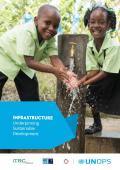
Through a systematic evaluation process, this report presents and explains the ability for infrastructure to influence all 17 of the Sustainable Development Goals (SDGs), including almost all of their targets. Accompanying these explanations is a rich set of examples that show how infrastructure projects are helping to advance the 2030 Agenda in a variety of countries and contexts around the world.
This document presents a framework for both public and private sectors to support planning, designing, and financing of infrastructure that is economically, financially, socially, environmentally, and institutionally sustainable. This document is intended to generate discussion amongst key stakeholders and serve as a basis for research and experimentation within the IDB and with clients; it should be considered as a working document.