
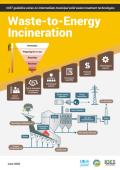
This guideline focuses on WtE incineration technology for MSW, mainly household waste and commercial waste, in urban areas of Asian developing countries.
Resilience is the capacity to prepare for disruptions, recover from shocks, and grow from a disruptive experience. The World Bank Group has developed a Resilience Rating System that provides guidance and specific criteria to assess resilience along two complementary dimensions.
This report shares international examples of collaborative resilience-building and synthesises lessons transferable to any city, based on local contexts and risks.
This paper provides an integrated framework to design an economic recovery strategy aligned with sustainability objectives through a multi-criterion, multi-stakeholder lens. The aim is to enable decisions by policy makers with the aid of transparent workflows that include expert evidence that is based on quantitative open-source modeling, and qualitative input by diverse social actors in a participatory approach.
This report discusses why green innovation is essential, the enormous economic as well as environmental opportunities that it represents, and how it might be achieved. It highlights key challenges in five priority sectors (resources and waste, construction, water, food, transport of goods) and provides recommendations for policy makers and businesses.
This report lays out a strategy for putting Americans back to work building a vibrant 21st century U.S. economy based on advanced technologies, good jobs, clean energy, climate safety, and economic security.
The report ‘Passing Gas: Why Renewables are the Future’ explores the Government’s pledge to the gas industry and uncovers some unsavoury truths: that emissions from gas are under-reported, that the second biggest user of gas in Australia is the gas industry itself, that the international gas market is in crisis and Australia is dangerously exposed to job losses and price volatility.
This study shows that combining the twin agendas of circular economy and climate mitigation gets us on a path to a well below 2-degree world by 2032.
The UNEP Global Climate Litigation Report: 2020 Status Review provides an overview of the current state of climate change litigation globally, as well as an assessment of global climate change litigation trends.
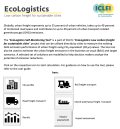
The EcoLogistics Self-monitoring tool is a calculation tool developed for cities to estimate their greenhouse gas emissions from urban freight transport.